-
The law of how late people choose to be
An organizer of a small research workshop, observing that all the locals were late, once remarked that “the closer people are to the venue the later they come.” If I remember my school days correctly, the same could have been said of my classmates. Of course, this is not a precise law, as people differ in how much they dislike being late (or early) to things, but on the whole, there could well be some empirical truth in this statement. In this post, I will sketch a little decision theoretic model that delivers this law.
We want to model a person deciding when to leave from home to go to work (or school or a conference venue or whatever their destination is). Let me phrase this as the problem of choosing an intended delay in getting there. Let me call this chosen intended delay
, which can be any real number. A negative delay means you are early. But
, where
is a random variable with zero mean and some non-negative variance
. The variance is my attempt to capture the random traffic conditions. A person who lives far from their destination quite possibly faces a higher variance in their travel time than a person who lives closer to their destination. The law I am looking for would then state that the higher the variance that a person faces for their travel time the earlier this person will be on average.
The decision maker chooses the intended delay, but what is their goal? I think it makes sense to assume that they prefer not to be late, and that in such a way that the later they are the worse it is. But it is probably also not great to be too early, as they could use the waiting time better at home before they leave. One option would be to consider preferences as captured by the utility function (often used as the loss function in statistics)
This utility function captures both ideas: ideally people would show up exactly on time, that is the realized actual delay
is zero, giving a utility of zero; they dislike being early and also being late, as in both cases the utility is negative. Also, the further away the realized actual delay is from zero (in both directions) the lower is this person’s utility.
However, a person with this utility function would choose to have zero expected delay regardless of the variance. To do so they would choose an intended delay
This is because under the given utility function the decision maker cares equally about being early and being late, the two concerns exactly offsetting each other. This may not be such a reasonable assumption for most cases. In many cases people probably worry more about being late than about being early. A simple way to accommodate such preferences is to consider the utility function
The multiplicative term, the function
is always positive, but is smaller for small (such as negative) delays and larger for large (such as positive) delays. Dividing by
in the exponent is a kind of normalization, that makes my life easier below. Different such positive and increasing functions would lead to different, yet qualitatively similar, laws at the end.
So, suppose our decision maker behaves as if they had such preferences as captured by this utility function. What would be their optimal choice? Their optimal intended delay would be the one that maximizes their expected utility. This problem can be written as
where,
indicates the expectation with respect to the random additional delay
Equivalently, the problem can be written as
We can solve this by differentiating (finding the first order conditions, using the product rule) with respect to
We obtain
Dividing by
noting that the expectation of a sum is the sum of expectations, and recalling that
we get
By the fact that
and noting that
the variance of
we get
Note that
and, thus, the optimal intended delay is simply
In words the decision maker would optimally aim to arrive one standard deviation early and we have our law of how late people are as a function of how far they start from their destination, or more correctly as a function of how much variance they face or at least perceive for their travel time.
Our very specific law, finally, states that people aim to be one standard deviation (of their random travel time) early! 😉
-
Recruiting when not all applicants want the job

In the German-speaking world recruiting professors at universities comes with an interesting complication. Many applicants are actually not interested in the job itself. They want to be offered the job only to use it to renegotiate their salary and general working conditions at their current university. In fact, in most universities, you can only get a pay rise if you have a job offer from another university. This creates a problem for the recruiting university for two reasons. It is not that easy to detect whether applicants are only interested in renegotiation at home and, in any case, university law does not allow discarding applicants just because the recruitment committee believes that they would not accept the job. In this post, I will explain how recruiters can circumvent these problems with the use of a little bit of game theory, more specifically, the theory of screening based on costly signaling.
Why is it important for the recruiting university to identify and discard applicants who would not accept the job in the end? Well, this is because the recruiting process is a long and labor-intensive one. It can take easily more than a year. It involves first meetings about the desired professorial profile, posting adverts, reading CVs and the applicants’ work, asking for external reviewers and giving them time to rank the candidates, inviting a list of candidates for hearings, holding these hearings and evaluating these, long negotiations about the salary and general working conditions, before finally, an applicant accepts or, more problematically, rejects the offer. Moreover, for whatever reasons, most universities only allow a final shortlist of three applicants, ranked as 1, 2, and 3, that will be offered the job sequentially. And, finally, on top of that, it is often the case that if none of the three candidates accepts the job, the university authorities reconsider whether the professorship position should be filled at all. The recruitment committee, thus, often has only one chance to fill this professorship position. So, if all three applicants on the list turn down the offer, it is a small disaster.
What can recruiters do to prevent this disaster? The starting point for solving our problem is the typically reasonable assumption that applicants who would accept the job offer tend to have a higher eagerness to get an offer than those who will just use it to renegotiate at home. And eager applicants would probably be prepared to do more hard work to get a job offer than the not so eager ones. But what work could this be? It has to be relevant for the job, otherwise, university law will not allow it. You can’t ask applicants to run 10 marathons as a requirement for becoming a professor of macroeconomic theory. You could ask them to present 10 of their research papers, but that they would love to do anyway, whether they want the job or not. But what you can do is to ask them to give a teaching presentation, and not just anyone, but one on a topic of your choosing. This is already not so pleasant for the applicants as it requires extra work that they cannot easily use for other purposes. On top of that, you can require applicants to explain what they would do if they were offered the job at this university, who of the people here they could see themselves working with, and how they would interpret and possibly change the current bachelor, master, and PhD curricula at this university. All this is unpleasant work for anyone, as it requires reading many pages of often slightly obtusely written curricula and often far from perfectly designed university websites. Moreover, this is work that the applicants cannot easily reuse for other purposes. But the eager ones would probably do it and would try to do it well. The not so eager ones will either not do it (and when they learn about what they have to do in the hearing, withdraw their application) or do it badly.
By asking applicants to do all this work, we have created what game theorists call a signaling game. Only the applicants themselves know their own eagerness. It is what game theorists call private information. Applicants can, however, signal their eagerness by doing all this work and doing it well. The recruiters’ aim is to construct this signaling game such that it has a so-called separating equilibrium: the eager applicants choose to do all this work and choose to do it well, while the non-eager ones either do not do it or do it badly. By creating a signaling game with a separating equilibrium, the recruitment committee is, thus, able to screen their applicants along this eagerness dimension.
A badly designed signaling game, from the recruitment committee’s point of view, has a pooling equilibrium, in which eager and non-eager applicants perform equally well. This would be the case if we only ask applicants to tell us about their research. As every researcher is happy to do that, we would in that case not be able to infer their eagerness for the job from their performance in the hearing.
Of course, even the best designed signaling game has its limitations. There is only so much we can reasonably demand from applicants and it could be that some applicants that are only interested in renegotiating at home are still sufficiently eager (to get their pay rise at home) that they do all this work regardless. But it typically helps at least to some extent.
-
Non-secret voting
Occasionally, I discuss strategic voting in some of my game theory classes. In particular, in past classes I have highlighted the trivial point that if people have only two choices (or candidates) to vote for, then it is a (weakly) dominant strategy to vote for your more preferred choice: voting for your more preferred choice can never lead to a worse outcome for you than voting for your less preferred choice. So, everyone will vote for their favorite choice and the vote winner reflects the majority preference. I regarded it as a bit of an embarrassment that such a voting game also has other equilibria, in which some people vote for their less preferred choice. For instance, if every one of the n-1 people other than you (with n ≥ 3) vote for choice A and you prefer choice B, it is immaterial if you vote for A or B because your vote will simply not matter. One can, in theory, even have the paradoxical situation that everyone prefers A over B and yet everyone votes for B. This is an equilibrium! Just not a very plausible one, I would have argued. I have recently learnt not to too quickly discard the weakly dominated equilibria of such a voting game.
(more…) -
A simple model of community enforcement

Here is the model for my previous blog post on (anonymous) community enforcement. I would call it a simplified symmetric (single-population) version of the model in the paper by Michihiro Kandori entitled “Social norms and community enforcement” in the Review of Economic Studies 59.1 (1992): 63-80. The point of this blog post is to demonstrate that what I have claimed in the previous post can be made logically coherent. I can provide a reasonable and simple artificial world in which we obtain cooperative behavior under the fear of triggering a tipping point as a subgame perfect Nash equilibrium, meaning a self-enforcing situation that is even self-enforcing when the tipping point has been triggered and there is no way back.
There are
people involved. These are those who are interested in going up the mountain, the people on the train, or the users of the communal kitchen. Time is discrete and runs from time points
until infinity. At every point in time
one person is randomly drawn to undertake the activity (go up the mountain, use the bathroom, or the kitchen) so that each person has a
probability of being drawn. The drawn person first observes (and only that) the state
of the resource (the amount of rubbish on the mountain, or the state of uncleanliness of the bathroom or kitchen). Then this person (after using the resource) decides whether to clean up (
– for cooperate or clean up) after themselves or not (
– for defect to use the language of the well-known prisoners’ dilemma game).
The instantaneous utility that the drawn person then receives shall be given by
, where
is the state of the resource – let us assume here that it is simply equal to the number of people who have been drawn before this person and who have chosen action
for not having to clean up. Let us assume that
, so this person receives less payoff the worse, that is the higher, the state of the resource
for
and then exponentially decays to the limit value of
when
. This means that they evaluate streams of utils
with the net present value
, where the
term is a convenient normalization.
For a well-defined game theoretic model, we need to identify players, their information, their strategies, and their payoffs. We have players and what they know and we have their payoffs. We have not quite yet defined their possible strategies, but we have specified their actions. To conclude the model we, thus, only have to define players’ possible strategies. These are all possible functions from the set of possible values of
, to the set of actions
. In principle, we should allow a bit more, as our players should probably remember what the state was at previous times when they were using the resource and also what they themselves did at these points in time, but this does not add or change anything of interest in our present analysis.
My claim then was that, at least for certain parameter ranges (for
,
,
So, suppose first that everyone uses this strategy. Then a randomly drawn player at some point in time, that we can, without loss of generality, call time
The net present value for choosing
.
For choosing.
The grim trigger strategy is a Nash equilibrium if and only if such a player would prefer
that is if and only if.
According to my calculations, this is equivalent to.
It is not straightforward to derive nice bounds for
as well, which I assumed anyway – I stated that I wanted
For the second part of the argument, suppose that the “trigger” has been released and that everyone is playing
. We can again reset the clock to zero without loss of generality. Then, the consequences of the two possible actions for this person are:
The net present value for choosing
.
For choosing.
It is in the best interest of this person to choose
The right hand side is lowest for(among all integer values for
), when it is
Rearranging, one can see that the right hand side of this inequality is greater than or equal to one, meaning that there is in fact no restriction on
Recall thatAll this together proves that, in the model given here, the strategy of cleaning up after yourself provided the resource is clean before you used it, and not cleaning up if the resource is not clean before you used it, is a subgame perfect Nash equilibrium: It is self-enforcing and the implicit threat of a tipping point in behavior is also self-enforcing. The model is very specific and many other versions would work just as well to make the same point.
-
Please leave the bathroom as you would like to find it

Many actions that we take affect other people that are not involved in the decision-making process. In economics, these effects are commonly referred to as “externalities” and the presence of externalities is one of the main concerns that may render free markets inefficient. “Inefficient” means that the ultimate outcome of people ignoring the externalities that they cause on other people is such that there is an alternative outcome that would be better (or at least as good) for all people! The presence of externalities is the main problem behind climate change and also at least one reason why we still have a problem with Covid-19. People, when making their holiday planning, car driving, air conditioning, car purchasing, et cetera decisions often ignore the effect their actions have on the environment and, thus, on all others. People make vaccination decisions weighing their own subjective assessment of the risks for themselves, without necessarily considering that with a vaccination they would also increase the protection from Covid-19 for everyone around them.
There are a variety of measures that governments or other organized groups of people can take to reduce the harm caused by people ignoring these externalities. One can, for instance, debate the (higher) taxation of fossil fuels or laws to force everyone to vaccinate. Often, such measures are probably necessary. There are (possibly rare) cases, however, in which even in fairly anonymous societies, the problem sorts itself out. It can do so through a mechanism of community enforcement. In this post I will describe an argument derived from a 1992 paper by Michihiro Kandori entitled “Social norms and community enforcement” in the Review of Economic Studies 59.1 (1992): 63-80. I will use the examples of mountain tops on which people do not leave their rubbish, bathrooms on trains that remain reasonably clean despite heavy usage, and communal kitchens (such as the one in my department) that despite a lack of regular professional cleaning service and despite a fair number of people using them, remain reasonably clean and usable.
I would first like to stress that in all three examples people are unlikely to observe your actions, so no one could punish you for bad behavior directly. When you are having your well-earned lunch or snack at the mountain top you are quite possibly alone at that moment. If you decide to leave some rubbish behind no one would see you doing it. I also hope that nobody can see what you do in the train bathrooms. And yes, occasionally you may not be alone in the department kitchen when you are making your coffee or warming up your lunch, but you are also often by yourself and unobserved. [It is, by the way, also not immediately clear what would happen if someone did observe your lack of adherence to the social norm of what is thought of as decent behavior (be it on the mountain top, the bathroom on the train, or the departmental kitchen). I often find that misbehavior in public may perhaps induce a fair bit of stern staring, but nothing much more than that. Nobody seems to want to engage in an altercation. An interesting phenomenon in its own right.] So why do people not leave rubbish on the mountain top, why do they clean up after themselves after using a bathroom, why do people wash, dry, and put away their dishes in the communal kitchen?
First, you might say, why wouldn’t you? Well, I guess the idea is that you would derive some benefit from not having to carry rubbish back down the mountain (after all it weighs something, also you might not have a good bag for your rubbish and it might soil all the other stuff you have in your backpack). You probably have to undertake some slightly unpleasant cleaning effort to keep the bathroom or the kitchen in a reasonable state. In fact, in your kitchen at home you might leave dirty dishes in the kitchen for quite some time, cleaning them later, while in a communal kitchen you probably do it (if at all) right away.
Then you might say, that ok, yes, it is a bit annoying having to do these things, but it is not too bad and anyway, you are a moral person. Maybe. I also would like to think that I am a moral person, but perhaps there is a more tangible reason behind our supposedly moral stance. [I generally don’t believe that people make all these decisions always so consciously. They may simply follow some more or less automatized protocols (perhaps as part of how they were raised as a child and now not often questioned). Then I will here provide a possible reason why such behavior might in fact be in your own self-interest despite the effort that is involved.]
Then you might say, and now you are on to something, that you have an interest in keeping the place clean, because you might want to use it yourself again. True, if it were your own mountain you would probably keep it clean. Perhaps you would not tidy up your kitchen immediately, but you would probably tidy it up at some point every day. But then you do not own the mountain and you are just one of many users. Wouldn’t this fact dilute your incentives to keep the place clean? Well, yes and no.
In fact, it seems quite plausible (and I have often observed this) that people do not clean up (much) after themselves if, for instance, the bathroom on the train is already in a bad state, even if they think that they might need to use it again. But they might well do so if the bathroom was clean when they started to use it. How can this be rationalized?
Let me sketch the model here (I will try and describe it in full detail in another post). Imagine you have a largish number of users of a place (such as the mountain top, the train bathroom, or the communal kitchen). Imagine that everyone uses this place infrequently but recurrently at random points in time. So, everyone always thinks that they may use this place again at some point in the future (I guess this works less well for the example of train bathrooms towards the end of the train ride – but then at that stage these bathrooms often are quite dirty). When they use it people can either be very clean (or clean up after themselves) or they can litter or soil the place. The instantaneous payoffs are such that people would (at that moment) prefer to litter or soil rather than clean. Finally, assume that nobody observes any actions of any other people, but everybody observes the state of the place when they use it (how much rubbish there is on the mountain, how clean the bathroom or kitchen is).
Then the following strategy, if employed by all people, can be made to be a subgame perfect Nash equilibrium of this symmetric stochastic repeated game, at least under some plausible conditions. [Subgame perfect Nash equilibrium means that this strategy is self-enforcing (everyone finds it in their interest to adhere to it when everyone else does) and does not involve a non-credible threat (any threats that are used to incentivize people to adhere to the strategy are also self-enforcing when they are supposed to be employed).] As long as the place is perfectly clean, keep the place clean (just as in the often-advertised statement “please leave the bathroom as you would like to find it”). If the bathroom is not perfectly clean, regardless of how bad it is, do not clean up after yourself.
If everyone follows this strategy, then the place would stay perfectly clean throughout. If, for some reason, somebody does not follow this strategy and does not clean up after themselves, this is a “tipping point” and the avalanche of dirt starts rolling: the place will just get dirtier and dirtier from then on. In reality, it may need more than one piece of rubbish on the mountain or more than just one sheet of loo paper on the floor to trigger the “tipping point”, and one could probably adapt the model (that you can find here) so that this would be the case. In any case we do get that people will behave very differently when the place is already a mess and when it is clean and it is, at least partly, the fear of triggering the tipping point that incentivizes people to behave and to internalize the externality that bad behavior would impose on others.
-
Allocating fruit among household members
This story is loosely based on real-life events. In the summer, members of my wife’s family all come together to stay with the “grandparents” in one large household. There are typically around 12 of us and we have many small problems. One of these is the allocation of fruit (and other snack items – but I will concentrate on the fruit problem as it is the easiest to describe) among household members. Mind you, this is not a problem that we talk about (much) in the household. Many of us perhaps do not even recognize it as a problem, but it is a problem and one that we solve inefficiently.
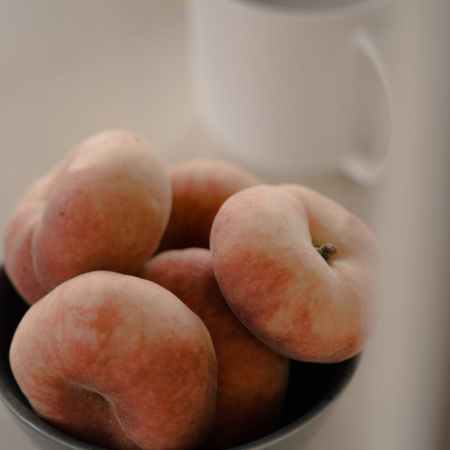
Consider peaches. Almost all household members like peaches, but we all vary in our exact preferences. Some of us would happily eat many peaches at various points in time, some would rather eat just one at a specific time of day. Some prefer peaches when they are still quite hard, some prefer them when they are essentially mush. [Some even like them slightly moldy, at least that’s what I infer from fruit choice observations that I made.] So, we all have different bliss points as to the optimal stage in the ripening process when a peach should be eaten. I could probably show you a graph with peach ripening stage on the x-axis and derived pleasure from eating a peach on the y-axis and you would see a nice concave (for the mathematical economist) initially upward curve that reaches a peak at some point, the bliss point, and then bends down again. Each family member would have a somewhat different curve with different bliss points and different up- and downward curves before and after the bliss point, respectively.
Having drawn such a picture, one could go on to mark the level of derived pleasure from eating a peach, at which you would rather eat a different fruit, an apple, say, or even just nothing (rather than a moldy peach, for instance). Again, all this is different for all household members and would also depend on the ever-varying quality of apples (and that bit about the quality of apples that matters to whichever household member we are talking about). To make the fruit allocation problem even more complicated, we all seem to have variable preferences. Some days, when the weather is bad for instance, just don’t seem to be peach days, at least for some of us. Or you may have eaten or drunk something else today that does not go well with peaches. On top of that, peach quality seems to vary from batch to batch and so our preferences change accordingly as well.
Why am I talking so much about preferences? There are two reasons. One, we all want to be kind and let someone else eat a peach instead of us if they also want it. Second, if we think of the problem from the social (household) planner’s point of view, that person would like to allocate peaches to individuals in some sort of efficient way, give more peaches to people who like them more, perhaps also keep fairness in mind, etc. The problem now is that none of us perfectly know other household members’ personal peach preferences on any given day. This is both a problem for the social planner as well as for each of us when we consider eating a peach. [There is also the additional problem sometimes that the number of available peaches is not even always clear. Sometimes extra peaches are “hidden” in the larder, so there are more than you think. Sometimes some peaches are actually reserved to be made into a cake – and this fact may not be known to everyone – although sometimes the social planner labels peaches accordingly.]
So how do we solve this allocation problem, why is it inefficient, and what would other mechanisms look like? For us, it all begins with the purchasing decision (with nowadays online delivery – this also impacts peach batch quality, by the way) made once or twice a week by the head of household, in her capacity as household chief procurement officer (or CPO). The CPO makes these decisions, considering an amazing number of factors based on an incredibly high degree of empathy towards all household members. Yet, even the CPO is not fully aware of all aspects of the daily changing peach preference profile in the household. At the end of the day the CPO settles on some quantity of peaches and this is where our problem now begins.
There are many mechanisms that we could use to tackle our fruit allocation problem. Let me first unashamedly tell you that we do not use a market mechanism. What would a market mechanism look like? Well, we would all be given a share of all fruit and snack items that were purchased. We would all have something called “money” that we all accept in exchange for the various fruit and snack items. We would meet regularly in a “market”, the kitchen for instance, where we all set up shop and trade among us. Market prices would, we would hope, adapt on a daily and perhaps even hourly basis so that supply meets demand, so that no peach is left uneaten and no additional peach would be wanted to be eaten at these prices. As we can assume that there are no worrying externalities when it comes to fruit and snack choices (except perhaps that parents sometimes worry about the kids’ sweet choices) such a market mechanism is expected to deliver a, so-called, Pareto optimal allocation, an allocation of fruit and snack items that is such that if we wanted to improve the material (fruit and snack) well-being of one individual by adjusting the allocation, we would have to reduce the material well-being of another. We could also aim for a reasonable degree of fairness by adjusting the initial allocation (before trade happens) of fruits and snacks.
But, surprisingly, this is not what we do. Our system instead is as follows. All the peaches (with some of the qualifications pointed out above) are simply displayed in the kitchen and anyone is free to take one at any time. I am pretty sure that this leads to an inefficient (not Pareto-efficient) allocation, at least in our case. Not for the reason you might think of at first. True, in a world full of people who are interested only in their immediate material (fruit and snack) well-being, like a world of small children perhaps, we might find that all the peaches are eaten by the first person who spots them. You might say that, while this may not be fair, this is ok from an efficiency point of view. But not necessarily. Imagine one person eating all the peaches, because he or she spotted them first, and another eating all the chocolates, because he or she spotted them first. They might have both been better off had they traded some of their peaches against chocolates and vice versa. But, in any case, this is not the problem we have. Our problem is that people are too altruistic, I believe, and too careful not to eat a peach that somebody else might also like, perhaps at a later stage in the ripening process. The sad result is that many peaches simply remain un-eaten (and thrown away) at the end of the day. Well, sometimes, to be fair, they are rescued and baked into a cake (at a point where I am happy not to know how advanced those peaches already were in their ripening process). But even in this latter case, some of us, perhaps all of us, might have preferred a peak peach over a post-peak peach cake.
You might say that communication should solve the problem. Maybe. However, we have many other problems (and not only problems) to discuss and the peach problem does not seem high up there on the list of problems. Also, even if we did, most of us would probably find it hard to articulate our exact peach preferences (we often don’t seem to have a good prediction of our future preferences ourselves). Also, we only come together for about a month in the summer every year, and for such a short time, it may be inefficient to spend hours solving the inefficiency in our peach allocation. So, as much as it pains me, as a trained economist, to accept inefficiencies, I guess I will just have to accept it.
-
Estimating the proportion of Corona cases
This short note makes one simple point. If you are interested in estimating the proportion of Corona infected people in some country or region, there is a simple and better (more precise) estimate than the one you obtain by computing the sample proportion. You can also read this in German here (and here).
Setup
Consider taking a (completely) random sample of
individuals in some population in order to estimate the proportion of people in this population who have the Corona virus. Let
denote this true proportion. I here assume that we already know, through potentially non-random medical testing, that there is a certain fraction
of the population who definitely have the virus (or have had it). I will refer to these people as those that were declared to have the virus. I assume that whatever medical test was used to obtain this number was perfect, at least in one direction: anyone who has been declared to have the virus this way also actually has it. As, thus, necessarily
we can write
where we interpret
as the multiplier or ratio of actual virus cases relative to the declared virus cases. I am here interested in estimating
from the random sample knowing
If we have an estimate for
-estimate with
.
When we take the random sample, we collect two pieces of information from each person. One, we check (again, for the sake of simplicity, with a perfect medical test) whether or not they have the virus. Two, we ask them (and the subject answers truthfully) whether they have already been declared as having the virus. I will call
the total number of virus cases in the sample and
the total number of already declared virus cases in the sample.
Estimator
Many people would probably be tempted to use
as the standard estimator for
and, thus, indirectly
as the standard estimator for
. It is given by
In the Appendix below I derive (in a few simple steps) this estimator as an approximation of the maximum-likelihood estimator for the present problem. It, therefore, does have all the nice properties that maximum likelihood estimators have. But even if you are a maximum likelihood skeptic, we can actually just directly compare the precision (for all sample sizes) of the two estimators, by looking at their variances.
First note that, like the standard estimator, the alternative estimator is unbiased as
The variance of the two estimators are
and, asis binomially distributed with number of trials
where the approximation is good whenIn this case the ratio of the two variances is given by
Thus, especially, if
Austrian Corona cases
In Austria, from 1st to 6th of April, a random sample of
was checked for the Corona virus. I will here ignore the disturbing sample selection problem that actually 2000 people were supposed to participate and 456 did not participate. Of those who participated the number of cases found,
was either 2 or 3. There was some weighting in these numbers which I am not fully informed about. I will ignore these issues here, but at least will look at both cases for
At the same day the proportion
(11383 declared cases among 8,636.364 people in Austria).
Using the, here also easily applicable, Clopper-Pearson method to compute 95\% confidence bounds, we get the following estimates and bounds derived from the two different estimators.
As you can see, the confidence bounds are much narrower for the alternative estimator than for the standard estimator.
A Thought
If we could assume, which sadly we often probably cannot, that the proportionality factor
while in Neusiedl am See in Burgenland it is about
Then a random sample of people in Landeck would produce a much more precise estimate for
) times as large as that for Landeck.
Another Thought
Of course, there is nothing specific about the setup here that makes it only applicable to counting virus cases. This estimator could be used in all cases in which we are interested in the true proportion of some attribute A in some population, when we know that only A’s can also have attribute B and we know how many B’s there are. Looking at it like that I am sure this estimator is known. So I am here just reminding you all about it.
Appendix
We here derive the alternative estimator as an approximation to the maximum likelihood estimator. Taking a truly random sample, we know that
Conditional on
is binomially distributed with number of trials
The likelihood function is, therefore, given by
The log-likelihood function is then proportional to
The maximum likelihood estimator, thus, has to satisfy
If
is small, we can approximate
by 1. We then get
Ifwe can approximate this further to get
-
A joke about economic methodology

This is a joke that I heard many times and once on a big stage at the 2014 annual meeting of the Verein für Socialpolitik where some supposedly important person from a supposedly important central bank (if I recall correctly) used it as a criticism of current economic methodology (as this person understood it) and generalizing it to mean it as a criticism of any economic methodology that uses math (if I understood this person correctly).
The joke goes like this. A police officer patrols the city at night and finds a perhaps slightly inebriated person apparently looking for something under the dim light of a street lamp. The police officer approaches said person and inquires: “Are you looking for something?” The perhaps slightly inebriated person responds: “Yes, I am looking for my keys.” “Where did you lose them?” the police officer asks. To which the perhaps slightly inebriated person answers: “Over there.” loosely waving at a bunch of bushes in the distance. “Why aren’t you looking for your keys over there then?” the police officer wonders out loud. “Well I only have light here” the slightly inebriated person replies.
How does this apply to research methodology in economics? Think of the slightly inebriated person in the joke as your economic researcher (now you see why this person had to be slightly inebriated). Think of the keys as the answer to a research question and think of the light as the research methodology that the economic researcher applies. The economic researcher is thus just as unlikely to find the right answer using their methodology as the slightly inebriated person is to find their keys.
I like this joke because it does ring true. I am sure it is a valid criticism of thousands of research articles in economics every year. But I do not come to the same conclusion that I believe the supposedly important person from a supposedly important central bank came to which is that, if I understood correctly, we should abandon serious mathematical modelling in economics (in favor, I believe this person indicated, of large scale simulation studies with intricately interwoven agents who all behave mechanically according to some simple heuristic). A brief aside: I do not mind if some people try simulation as a means of getting to an answer. I did not intend to here write a criticism of simulation as a methodology, although I am not overly optimistic of its usefulness. Simulation, as I see it, can only ever provide a fairly dim light. But it could on occasion be in just the right place to find the beginnings of an answer. But I believe that when we find a mathematical model to be unhelpful we should not abandon math completely but we should try and find or develop a more appropriate math to deal with the situation.
The more math we have at our disposal the more stats we have at our disposal the more light we have and the more likely will it be that we will find answers to our economic problems.
A final note, perhaps, and again very much only my opinion: the more brilliantly creative and intuitive you are the less you may need to know the tools. But then again who is brilliant?
-
On towels, parking spots, and job protection
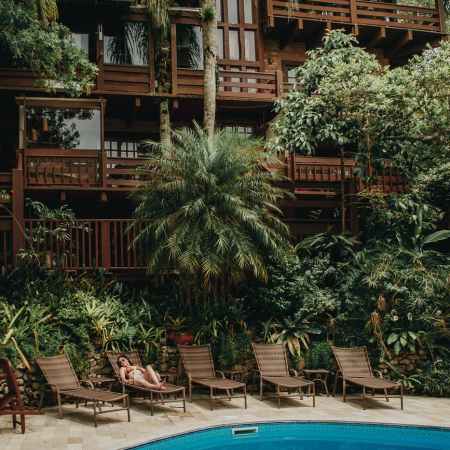
You just arrived at your dream summer resort. You had a restful night almost entirely uninterrupted by mosquitoes. You just woke up and had a leisurely and plentiful breakfast. You are making your way to the swimming pool that looked so enticing on the webpage. And what do you find? You find towels. In fact you find towels on every single one of the lounge chairs that the resort has provided. While almost no lounge chair is actually occupied, not a single lounge chair is really available. Economics is supposedly (primarily?) about the allocation of scarce resources. So what about the scarce resource that is a lounge chair next to the pool in a holiday resort?
Let us first approach this problem from the viewpoint of the resort. How did they decide how many lounge chairs they would provide? Probably there is a bit of a space problem. Or let’s say it differently, there is probably a temptation for the resort management to divide the space between hotel rooms and lounge chair space in such a way that there are more rooms so that they can have more paying guests. It probably makes little sense to have more lounge chairs than beds (unless the resort was open to day visitors as well – which we shall not assume here). But should one have fewer lounge chairs than beds? I can imagine the conversation in management about this issue. Somebody will have pointed out that it’s probably ok to have more beds than lounge chairs because not all people who sleep in the resort will also need a lounge chair. Some guests may make day trips to other places. Also even if all guests will want a lounge chair, they probably do not all need one at the same time. The average guest might spend, let’s say four hours every day in a lounge chair (seems a long time to me). And not all guests will want to spend the same four hours in lounge chairs. There may be morning people and afternoon people, before lunch people and after lunch people, early lunch and late lunch people, et cetera.
In fact they are probably right (these are after all just the managers I imagine in my head). It is probably true for many resorts that at any given moment during the day the actual number of lounge chairs needed is smaller than the total number of lounge chairs in the resort. After all we often observe many lounge chairs with only a towel on it. So there is actually no real scarcity and yet we find that there are some people who cannot find a lounge chair when they want one. The problem is that this “game” between the resort guests can have two equilibria and it is easy to get stuck in the “bad” equilibrium.
To see this consider this. What do you do the next day do when you observe that all lounge chairs are reserved through the early placing of towels? Well, you have two options. Either you give up your hope of getting a lounge chair or you get up early and place a towel on a chair yourself.
What do you do if you find that there are always lounge chairs available (in nice locations around the pool)? You don’t even think about getting up early just to place a towel on a chair.
This means that both situations are self-enforcing. If no one places towels in the morning (and there is no real scarcity at any given moment in time) then no one will even consider reserving lounge chairs with towels in the morning. If however people do place towels in the morning and, if you do not you do not find a lounge chair when you need one, you will quite possibly get up early in the morning to do the same. In fact, there may be a race such that you have to get up earlier and earlier to find an empty lounge chair for your towel. An equilibrium is then found in such a way that exactly (in pure theory only) so many people get up early enough to place a towel on a lounge chair as there are lounge chairs. These people are those that care relatively less about sleeping in the morning. This, by the way, is called Harsanyi purification (of mixed Nash equilibria).
So how can you slip from the “good” equilibrium to the “bad” one and what could the resort do to prevent the “bad” equilibrium? I guess that most resorts have a variety of more or less attractive lounge chair locations. So I guess it is possible that some people start putting towels on the most attractive locations, which then starts a gradual chain reaction that eventually all lounge chairs get “toweled” if I am allowed to invent this word (it is not underlined in my editor, so I guess this word exists already). Another possibility is that some large enough group of tourists, perhaps with experience from other resorts and not knowing that in their current resort there is no real need for this, do get up and place towels and cover so many chairs that for the remaining chairs there now is a real scarcity at some point in time.
If the true reason for the lounge chair is that we are indeed simply in a bad equilibrium then the resort can introduce some simple and effective policy measures to restore the good equilibrium. They could, for instance, simply not allow the “toweling” of lounge chairs. They could remove towels after some time. A bit costly, this one, as someone has to monitor the pool area and enforce this rule. But they may not need to do it for too long as, once the good equilibrium has reestablished itself, they can stop enforcing the rule (as it is self-enforcing).
So what about the parking spots and job protection, the other two topics I mentioned in the title? Well, you can figure out for yourself how one could use the towels as an analogy for these two problems.
-
Inspired by Goffman – the secret handshake
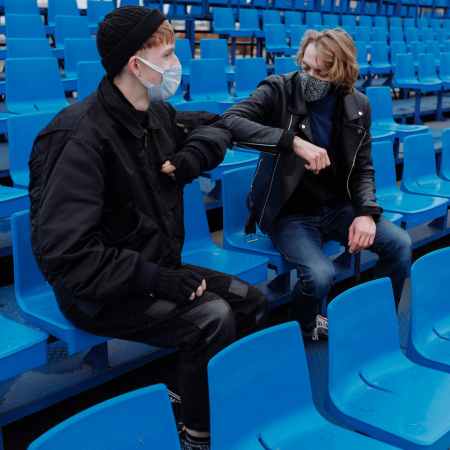
You are visiting another university and have arranged to meet someone from that university in the lobby of the hotel you are staying at. The hotel lobby is busy with many people and (for some strange reason) neither you nor the person you are supposed to meet have recognizable pictures on their webpages. How will you find each other? What is the mechanism behind it? How is this possible at all?
I am continuing with my game theory inspired by Goffman’s work. This is an excerpt of what Goffman says about this on page 95, Part Three “Focused Interaction”, Chapter 6 “Face Engagements” in his “Behavior in Public places”:
“As these various examples suggest, mutual glances ordinarily must be withheld if an encounter is to be avoided, for eye contact opens one up for face engagement. I would like to add, finally, that there is a relationship between the use of eye-to-eye glances as a means of communicating a request for initiation of an encounter, and other communication practices. The more clearly individuals are obliged to refrain from staring directly at others, the more effectively will they be able to attach special significance to a stare, in this case, a request for an encounter. The rule of civil inattention thus makes possible, and “fits” with, the clearance function given to looks into others’ eyes. The rule similarly makes possible the giving of a special function to “prolonged” holding of a stranger’s glance, as when unacquainted persons who had arranged to meet each other manage to discover one another in this way.”
This is wonderful stuff. I am here just going to explain in game theoretic terms what is going on in the background of the last sentence of the quote. So we have two people who would like to meet. But there are many other people there as well, who we cannot ex-ante distinguish from the person we would like to meet. So how should we model this? I would like to model this as a one-at-a-time two person game of two people potentially trying to engage with each other. I would say that there are two types of individuals, type A who would like to meet another type A and type B who would like to be left in peace. This is private information. Only I know whether I am type A (trying to find another type A) or type B (hoping to be left in peace). This means we have a game of incomplete information. So there are two players and each one could be of type A or type B. To close the model informationally, so that we can work with it, it makes sense here to assume that both players of all types have common knowledge of the likelihood of anyone being of type A, let’s say of
. This is, of course, an empirically completely implausible assumption, but you will see that it actually does not play a huge role. In fact we will find an equilibrium of this game that will be an equilibrium for any positive (and relatively small)
. The game has a first stage, which I will describe in a bit. Let me first describe the second (and last) stage. Eventually both players can unilaterally choose to verbally engage with the other player. So let us give both players two strategies each: engage (E) and not engage (N). So we have players (each of possibly different types) and we have strategies for each player. All that is left is to specify their payoffs. Well, what do we want? We want that B types do not want to engage. So let’s give B types a zero payoff whenever they choose E and let’s give B types a payoff of one if they choose N. Note that this gives B types a (strictly) dominant action of choosing N (not to engage).
What about A types? They want to engage with other A types but do not want to engage with B types (consider the embarrassment and need for a lengthy further explanation when you inadvertently try to engage with the wrong person). So they should get a payoff of zero if they engage with a B type and a one if they do not engage with a B type. They should get a zero if they fail to engage with an A type and get a one if they do engage with a B type. All that matters, of course, is that one is larger than zero. We could have chosen 100 and 6 and it would all be the same.
So let us summarize this in matrix form. There are four possible encounters, I am an A type and meet another A type, I am an A type and meet a B type, I am a B type and meet an A type, and I am an A type and meet a B type. Here are the payoffs we just chose for me in these for encounters (I choose row, my opponent chooses column):
If this is the game and there is nothing else, and if
, then there is a unique equilibrium in this game in which both A and B types choose not to engage. B types do this because they find not to engage a dominant strategy (maybe they don’t even think about the possibility of engaging anyone) and the (in equilibrium sad) A types do this because it is (sufficiently) more likely that their opponent is a B type so that they are too worried about being embarrassed if they try to engage them.
So this is all very sad. But luckily the game people actually play is not fully described yet. We have not taken into account Goffman’s statement about the “special function to “prolonged” holding of a stranger’s glance”. Before the two players decide whether or not to engage verbally, they can first both send a (not very costly) “message” to their opponent by holding a prolonged stare. Now Goffman in his book in the pages leading up to the quote I provided above discusses at length why prolonged stares are typically not used by people as these are considered rude. You can read this for yourself. Whatever the reason, it seems a fact that people do not ordinarily treat other people to a prolonged stare. This means, that we can choose to deliberately employ this otherwise almost never used “message” in special encounters. This “message” can then act as a secret handshake. By the way I first encountered this secret handshake in a just slightly different context in a 1990 paper by Arthur Robson (Journal of Theoretical Biology 144, 379-396). It supposedly is very similar (but I again think the context is slightly different – actually quite different – one has to be careful to distinguish between cooperation and coordination I think) to the so-called green beard effect allegedly proposed by William Hamilton in 1964 and Richard Dawkins in his popular 1976 “selfish gene” book.
So how does this secret handshake work here and how do we model it? Before the two players play this game as described so far, they can first choose whether or not to send this message of the prolonged stare. So how can this generate new outcomes? Well, the two players can condition their engagement level on whether or not their opponent (and they themselves) employed this prolonged stare. In fact the following behavior is an equilibrium of this game. Every A type first uses a prolonged stare, B types do not. Then an A type decides to engage if and only if their opponent gave them a prolonged stare as well. In this equilibrium everyone is now as happy as they can be. B types get briefly stared at by some A types, but are then not engaged and they of course never engage their opponent themselves, while A types by means of the prolonged stare are able to identify other A types and engage exactly those. This is I think a fair description of how and why indeed two strangers can thus meet in a busy hotel lobby in such a way that disinterested others would not even notice that the two did not know each other before.
One of my PhD students at CICS (Research Center for Social Complexity at the Universidad del Desarrollo in Santiago, Chile) told me the following story. There used to be a bar in Santiago called the Club Amsterdam. You could order a beer, get a beer and then pay. You could also, allegedly, order a beer and at the same time put down a 5000 pesos note on the table and you would get a beer and a small portion of cocaine. No more communication was needed. I am not sure whether this situation should be modelled by the game I provided above – maybe one should have to think about the police here – but the problem seems quite similar and its solution employs a secret handshake as well.


![\displaystyle \max_{d} - \mathbb{E} \left[(d+X)^2 e^{\frac{d}{\sigma}}\right],](https://s0.wp.com/latex.php?latex=+%5Cdisplaystyle+%5Cmax_%7Bd%7D+-+%5Cmathbb%7BE%7D+%5Cleft%5B%28d%2BX%29%5E2+e%5E%7B%5Cfrac%7Bd%7D%7B%5Csigma%7D%7D%5Cright%5D%2C+&bg=ffffff&fg=3a3a3a&s=0&c=20201002)
![\displaystyle \min_{d} \mathbb{E} \left[(d+X)^2 e^{\frac{d}{\sigma}}\right].](https://s0.wp.com/latex.php?latex=+%5Cdisplaystyle+%5Cmin_%7Bd%7D+%5Cmathbb%7BE%7D+%5Cleft%5B%28d%2BX%29%5E2+e%5E%7B%5Cfrac%7Bd%7D%7B%5Csigma%7D%7D%5Cright%5D.+&bg=ffffff&fg=3a3a3a&s=0&c=20201002)
![\displaystyle \mathbb{E} \left[2(d+X) e^{\frac{d}{\sigma}} + (d+X)^2 \frac{1}{\sigma} e^{\frac{d}{\sigma}} \right] = 0.](https://s0.wp.com/latex.php?latex=+%5Cdisplaystyle+%5Cmathbb%7BE%7D+%5Cleft%5B2%28d%2BX%29+e%5E%7B%5Cfrac%7Bd%7D%7B%5Csigma%7D%7D+%2B+%28d%2BX%29%5E2+%5Cfrac%7B1%7D%7B%5Csigma%7D+e%5E%7B%5Cfrac%7Bd%7D%7B%5Csigma%7D%7D+%5Cright%5D+%3D+0.+&bg=ffffff&fg=3a3a3a&s=0&c=20201002)
![\displaystyle 2 \sigma d + \mathbb{E} \left[(d+X)^2\right] = 0.](https://s0.wp.com/latex.php?latex=+%5Cdisplaystyle+2+%5Csigma+d+%2B+%5Cmathbb%7BE%7D+%5Cleft%5B%28d%2BX%29%5E2%5Cright%5D+%3D+0.+&bg=ffffff&fg=3a3a3a&s=0&c=20201002)


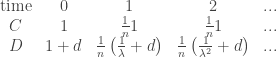


![\mathbb{E}\left[\hat{\mu}_A\right]=1+\frac{\mu qn - qn}{qn} = \mu.](https://s0.wp.com/latex.php?latex=+%5Cmathbb%7BE%7D%5Cleft%5B%5Chat%7B%5Cmu%7D_A%5Cright%5D%3D1%2B%5Cfrac%7B%5Cmu+qn+-+qn%7D%7Bqn%7D+%3D+%5Cmu.+&bg=ffffff&fg=3a3a3a&s=0&c=20201002)
![\mathbb{V}\left[\hat{\mu}_S\right] = \frac{\mu(1-\mu q)}{qn} \approx \frac{\mu}{qn},](https://s0.wp.com/latex.php?latex=+%5Cmathbb%7BV%7D%5Cleft%5B%5Chat%7B%5Cmu%7D_S%5Cright%5D+%3D+%5Cfrac%7B%5Cmu%281-%5Cmu+q%29%7D%7Bqn%7D+%5Capprox+%5Cfrac%7B%5Cmu%7D%7Bqn%7D%2C+&bg=ffffff&fg=3a3a3a&s=0&c=20201002)

![\mathbb{V}\left[\hat{\mu}_A\right] = \frac{(\mu-1)(1-q(\mu-1))}{qn} \approx \frac{\mu-1}{qn},](https://s0.wp.com/latex.php?latex=+%5Cmathbb%7BV%7D%5Cleft%5B%5Chat%7B%5Cmu%7D_A%5Cright%5D+%3D+%5Cfrac%7B%28%5Cmu-1%29%281-q%28%5Cmu-1%29%29%7D%7Bqn%7D+%5Capprox+%5Cfrac%7B%5Cmu-1%7D%7Bqn%7D%2C+&bg=ffffff&fg=3a3a3a&s=0&c=20201002)
![\frac{\mathbb{V}\left[\hat{\mu}_A\right]}{\mathbb{V}\left[\hat{\mu}_S\right]} = \frac{\mu-1}{\mu} < 1.](https://s0.wp.com/latex.php?latex=+%5Cfrac%7B%5Cmathbb%7BV%7D%5Cleft%5B%5Chat%7B%5Cmu%7D_A%5Cright%5D%7D%7B%5Cmathbb%7BV%7D%5Cleft%5B%5Chat%7B%5Cmu%7D_S%5Cright%5D%7D+%3D+%5Cfrac%7B%5Cmu-1%7D%7B%5Cmu%7D+%3C+1.&bg=ffffff&fg=3a3a3a&s=0&c=20201002)





-
Subscribe
Subscribed
Already have a WordPress.com account? Log in now.
 The Game Theory of Everyday Life