-
Gambling laws
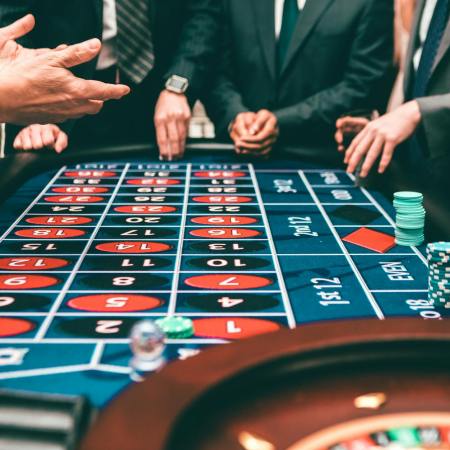
There seems to be a universal consensus that gambling is something people should be wary about. Through gambling, you can lose a lot of money in a short amount of time; you can also become addicted and lose money steadily; and by doing so, you may not only negatively affect your own well-being but also that of your spouse and kids and maybe even other people. To protect people from gambling, at least to some extent, most countries have a legal definition of gambling and additional legislation to regulate it. [Countries differ in how much they regulate gambling: some countries have very permissive gambling laws, others (like Austria) even make it a state monopoly so that no one can offer gambling services unless they have a (rarely given) special state license.]
My interest in this matter arose when a lawyer asked me to help him understand some statistical jargon that an expert witness was using in a court case. The court case centered around the question of whether a given online game was a “game of chance” as defined in the Austrian legal text. The definition of a “game of chance” in Austria is similar to that of many other countries. It says that a game of chance is (translated fairly literally by ChatGPT) “a game in which players are required to provide a consideration of monetary value and in which the decision on the outcome of the game depends solely or predominantly on chance.” In plain language, a game is a game of chance, according to Austrian law, if there is something of monetary value at stake and the outcome of the game is mostly driven by chance. And, at least in Austria, offering such “games of chance” as a business is not allowed (unless the business is run by the government).
I don’t find this definition of a “game of chance” very satisfying. Luckily, I have a game-theoretic definition of a “bad game” and in what follows I will try to persuade you that my definition is much better than the current definition of a “game of chance.”
One could probably be even more philosophical than I will be here, debating if there even is such a thing as chance. But I accept that chance is something we can meaningfully talk about. However, I would at least differentiate between three forms of chance (as the current literature on decision theory does).
There is risk (or objective uncertainty), which is the type of chance you encounter in casinos, where we (mostly) all agree about how to quantify chance by means of probabilities. Most of us would agree, for instance, that a ball thrown into an (officially checked to be fair) spinning roulette wheel has an even chance (of 1/37) of landing at any of the 37 numbered holes. Similarly, most of us would agree that the probability of drawing, say, the ace of hearts, from a properly shuffled deck of 52 cards is 1/52.
Then there is subjective uncertainty (or Knightian uncertainty, or ambiguity), which is such that we all agree about the possible outcomes, but do not necessarily all agree about their likelihoods. Think of a football (soccer) game, for instance. We all know that the final outcome is that either one team wins, or the other, or that there is a draw. But we don’t necessarily all have the same opinion about how likely a draw, say, is.
Finally, there is the type of uncertainty, where we don’t even all agree about the possibilities that could happen, let alone agree on how to attach probabilities to these possibilities. This uncertainty is often referred to as unawareness in decision theory, see Burkhard Schipper’s unawareness project.
If we are talking about chance, especially in a supposedly well-defined legal context, I would have liked to see these formal distinctions made and addressed. It matters, I feel. Compare the following two games, for instance: blackjack, for which most of us would agree that all chance is objective, and rock-paper-scissors, in which there is no actual device used to generate chance. Blackjack would fall under the legal definition of a “game of chance” if played for money. I am not so sure about rock-paper-scissors (if played for money). [You know the game: rock beats scissors, scissors beat paper, and paper beats rock; and these are your only three choices.] One could argue that there are only two components in this (and any) game that generate outcomes: chance (of which there is none in this game) and the players’ behavior. Now we know that the minimax recommendation for playing rock-paper-scissors (which is also its unique Nash equilibrium) is to play uniformly randomly, that is, to use each of the three strategies with a probability of 1/3 each. If that is what the players do, then there is chance in this game. But would the players play like this? At the very least, I would say that the game exhibits subjective uncertainty, and this uncertainty exclusively derives from the other player’s strategy. Austrian law is often interpreted as if the only factors that can determine the outcome of any game are chance and the players’ skill. But the only chance in rock-paper-scissors is that generated by the players, which in turn is determined by the players’ skill. A bit of a muddle, I find.
Now, consider tic-tac-toe. Most of us would probably agree that the game has absolutely no chance component. The game indeed has a (pretty simple) optimal strategy for both players and, if both play that, the game ends in a draw. But now suppose that an entrepreneur offers a platform that allows people to play tic-tac-toe for money (and the entrepreneur keeps a percentage share). Suppose, for the sake of the argument, that a range of people play this game for money on this platform, with some who understand the optimal strategies and some who do not. Then these games do not all necessarily end in a draw. I do not see, however, how this game could satisfy the legal definition of a game of chance, as it is hard to argue that there is any chance in this game at all. Just as there isn’t in chess (or checkers, or Connect Four). Yet, if these games are played for money and organized by an entrepreneur who keeps some of this money, to me this seems rather similar to playing blackjack in a casino (at least for some players).
There are games that are played for money (to an extent) that are not typically classified as “games of chance,” even though they satisfy the legal definition of a game of chance if we allow subjective uncertainty also to count as chance. Take any sport, really. Consider a football game or a game of golf, for instance. The existence of a betting market about these sports proves that there is “chance” at least in the eyes of (most of) the beholders. And there is indeed a chance component to these games, probably not only derived from the players’ strategies, but also from varying weather conditions and other factors (think of gusts of wind in golf, for instance). If we accept “chance” to also cover subjective uncertainty and if these games are offered with money at stake, then these games also qualify as “games of chance.” [Most sports have the feature that players’ “salaries” depend on their success; so, there is clearly some money at stake.]
In fact, sports betting and even financial (stock market) trading satisfy the legal definition of a game of chance. This is definitely so, if we allow that other people’s behavior, which is typically the only thing that determines the betting odds and the prices of financial assets, counts as “chance.” How much a bet or a financial asset pays out depends on more subjective uncertainty (about how the sporting event results or about how the price of the financial asset is revised over time, which in turn is determined by some people’s behavior). If we were to believe in the so-called efficient market hypothesis (which we probably should, at least to a high degree, see a previous post of mine), then the betting odds or the prices of assets accurately reflect all pertinent information that there is out there. This would make the uncertainty involved in sports betting and on the stock market almost objective. In fact, much of financial theory assumes that this is so. But then, nobody could really know more than all there is to know – nobody can be much better at betting or at financial investments than anyone who does not do silly things, so skill doesn’t really come into it. But then, sports betting as well as financial trading are games of chance according to the legal definition.
Apparently, neither sports betting nor financial trading is currently considered a game of chance in Austria. Offering such services seems to be allowed at the moment. Maybe this is the case because sports betting and financial trading have been classified (incorrectly, in my opinion) as games, in which the skill component is higher than the chance component.
There is a nice attempt to assess how much skill versus chance there is in games in a paper by Peter Duersch, Marco Lambrecht, and Joerg Oechssler, Measuring skill and chance in games, European Economic Review, Volume 127, 2020, 103472. The idea is simple: for whatever game you are interested in, consider or construct an (ELO) ranking of the players that play this game. Let me here suppose that we are dealing with a two-player game. Then, using data on game play, estimate the probabilities of one of the players winning the game as a function of the two players’ (ELO) rank. If a player with a low rank still has a decent probability of winning against a player with a high rank, then the game has a large chance component. I believe that if one were to extend this approach to sports betting and financial trading, one would find that there is mostly chance in both of these “games.”
In any case, this is not the direction I want to take here – although it would be interesting to have a look at. I would recommend a different definition, maybe not of a game of chance, but of a “bad game” that governments might want to regulate. My definition would be this: A game is “bad” if it is subzero-sum for the contestants. In other words, the total net payout to the players of this game is negative. No mention of chance is necessary. Nobody has to assess how much chance versus skill there is, either. All we would need to check is whether the total net payout to players is negative. Doing this is very easy.
Let me revisit the examples of games I used above to see whether they are “good” or “bad” games. Let’s begin with games in the casino: they are all “bad.” This is because the players put in money, and that money is collected and paid out again, with the casino keeping a percentage share. According to my definition, poker is just as bad as blackjack or roulette. Note, however, and this is important, if poker is played live on TV and many people watch this (and at least indirectly pay for this privilege by watching commercials), such that the total net payout to the poker players was positive, then this would be a “good” game. Most sports are “good” games like this. Sports competitions are performed for the benefit of spectators who pay to watch the event. The money this generates is (partially) used to pay the contestants’ wages or prizes. Similarly, there are two ways one could offer a platform for people playing rock-paper-scissors for money. If all that happens is that the platform makes this possible and takes a cut of winnings, then this is a “bad” game. If people are paying to watch this game, such that some added value is generated and redistributed to the players to make the game more than zero-sum, then this is a “good” game.
The definition of a bad vs. a good game is also great to differentiate sports betting and financial market trading. Sports betting is typically offered by a broker who simply keeps a cut of the money that is placed as bets before paying out the rest. So, the game is subzero-sum and “bad”. Financial assets typically grow in value over time, that is, they have a positive return on average. The game of financial trading is super-zero-sum and thus “good”.
Now, you could still have qualms even about “good” games. In “good” games, people could also lose a lot of money, even though, on average, net winnings are positive. If lawmakers worry about this, they could add limits to how much you can bet or trade. One should, however, probably have different limits depending on the perceived risks of financial assets (one could lose much more trading options than trading stocks, for instance). Indeed, this is what the Basel framework does for banks (adopted in most countries): banks are required to hold adequate capital to cover their risk exposure; the minimum capital requirement depends on the risk of the bank’s portfolio of asset holdings. Something like this could also be imposed on private financial traders if one is worried about them losing too much even in “good” games.
Anyway, I feel my definition of a “bad game”, games that are subzero-sum, would be a much better basis for gambling law than the hard to assess current legal definition of a “game of chance.”
-
Dirk Gently’s Holistic Decision Theory – Model Uncertainty

Dirk Gently talks a lot about the impossibility of certain events that have actually happened. In “Dirk Gently’s holistic detective agency,” Dirk is much taken by a conjuring trick a professor performs at a high table dinner at one of the Cambridge colleges. Only he seems to realize that the particular trick is actually totally impossible, at least given what we know about the world. The professor makes a “salt cellar” disappear and then reappear in a 200-year-old pot that needed cracking open to get to the salt cellar (on pages 34-37 of my edition of the book). Dirk calls this event (p. 189) “completely and utterly impossible.” After asserting that, luckily, “there is no such word as ‘impossible’ in my dictionary,” in fact a lot of pages are missing, he rephrases this to “completely and utterly – well let us say, inexplicable … [I]t cannot be explained by anything we know.” What he means is that the model of the world that we have cannot explain this phenomenon. Because of this fact we should entertain a different model of the world. Indeed, eventually it becomes clear that the professor was able to travel back in time 200 hundred years, something our model of the world does not allow, and to have the salt cellar put into the pot when it was made. Dirk’s ability to think beyond the current model of the world made it possible for him to understand the seemingly impossible.
In “The long dark tea-time of the soul” Dirk goes further in claiming that he often prefers an impossible explanation over possible but highly improbable ones. Among a number of interesting patients in the ”Woodshead hospital,” there is a ten-year-old girl sitting in a wheelchair and murmuring constantly and “soundlessly to herself.” She is murmuring stock market prices, but yesterdays (with a precise 24-hour delay). She has no apparent access to outside news of any kind. Yet, the psychologists explains that “[w]ell, as a scientist, I have to take the view that since the information is freely available, she is acquiring it through normal channels.’’ This is happening on pages 121-123 in my edition of the book.
When told about this, Dirk is confronted with Sherlock Holmes’ (I guess really Sir Arthur Conan Doyle’s) statement that “[o]nce you have discounted the impossible, then whatever remains, however improbable, must be the truth.” Dirk responds with “I reject that entirely, the impossible often has a kind of integrity to it which the merely improbable lacks.” Applied to the present case of the girl in the wheelchair he states that “[t]he idea that she is somehow receiving yesterday’s stock market prices out of thin air is merely impossible, and therefore must be the case, because the idea that she is maintaining an immensely complex and laborious hoax of no benefit to herself is hopelessly improbable. The first idea merely supposes that there is something we don’t know about, and God knows there are enough of those. The second, however, runs contrary to something fundamental and human which we do know about. We should therefore be very suspicious of it and all its specious rationality.”
I like Dirk’s statement a lot, for two reasons. The first is that Dirk points out that we should be aware of model uncertainty. We should always entertain the possibility that the model that we have about the world is not completely correct, and sometimes new evidence should lead us to reconsider the model. This is somewhat comical in Dirk’s context, where we are really talking about the physics of the world (although of course physics models can also be wrong). The idea is much more important, however, in game-theoretic models (as used most heavily in economics), as these models are typically radical simplifications of the world. If a game-theoretic models leads to bizarre predictions (or policy implications), you should probably go back to the drawing board for a more appropriate game-theoretic model, rather than accept these predictions as truth. By the way, Dirk’s approach of questioning the underlying model based on possibly but highly improbable observations given the model, is a standard tool of statistics. Indeed, in statistics, we tend to reject a null hypothesis (our current model of the world) if the kind of data that we observe is sufficiently hard to explain with the null hypothesis; if the p-value is below the level of significance that you choose to begin with (you know, the often chosen
of 5% for instance). So, while the way Dirk says this, may appear ludicrous, he is really just stating sound scientific reasoning.
The second part of Dirk’s statement that I like is that he puts human incentives even above physical laws (of a possibly flawed physical model). Why would this ten-year old girl maintain such a “laborious hoax” that is “of no benefit to herself”? Taking human incentives into account is what game-theoretic models (with a longer tradition in economics) are really good at. Douglas Adams would have made a great game theorist (or even economist ;).
-
Dirk Gently’s Holistic Decision Theory – Model Choice

On pages 146-150 of my edition of Douglas Adams’ “Dirk Gently’s Holistic Detective Agency,” Dirk Gently has a phone conversation with one of his clients, whose cat he has not been able to find in the past seven years. They are debating the bill that the holistic detective had sent, and we only hear his side of the conversation. I will give you the key snippets: “Sadly, no sign as yet of young Roderick, I’m afraid, but the search is intensifying as it moves into what I am confident are its closing stages.” … “I grant you, Mrs. Sauskind, that nineteen years is, shall we say, a distinguished age for a cat to reach, yet can we allow ourselves to believe that a cat such as Roderick has not reached it?” And after some very entertaining bits about Dirk’s “quantum mechanical view” of the world and the psychological cost his client’s skepticism puts on him (also itemized on the bill) we get to Dirk’s decision-theoretic view: “I do appreciate, Mrs. Sauskind, that the cost of the investigation has somewhat strained from its original estimate, but I am sure that you will in your turn appreciate that a job that takes seven years to do must clearly be more difficult than one that can be pulled off in an afternoon and must therefore be charged at a higher rate. I have continually to revise my estimate of how difficult the task is in the light of how difficult it has so far proved to be.”
The pleasure one gets from reading this derives from the strong suspicion that Dirk’s implicitly stated model of the underlying problem is probably not appropriate, certainly different from his client’s model, and probably also not Dirk’s true model.
Dirk’s implicit model could be something like this. The cat is equally likely in any one of a large number of, say k, places. [Let us ignore the complication that arises from the possibility that the cat could, in reality, also move while the search is going on.] The cost of searching differs from place to place. Dirk seems to work under the hypothesis that Mrs. Sauskind attaches a very high value to finding her cat, so that the search should go on at any cost. Assuming the detective searches optimally (given his model), he goes to the place with the lowest search cost first, then the second lowest, and so on. Given this optimal behavior, the revised expected total cost of searching for the cat increases with every additional fruitless search. Moreover, the daily additional search cost goes up every time. Under this model, Dirk is then indeed right in saying that he has to “continually revise [his] estimate of how difficult the task is in the light of how difficult it has so far proved to be”.
Now, Mrs. Sauskind’s model of the problem seems to be different in at least one crucial aspect. She appears to have the view that, while there may be the same places that the cat could be in, there is also a non-negligible possibility that the cat is already deceased (or simply unfindable). This means she attaches a total probability to the cat being at any of the k places that is less than one. Assume, therefore, that Mrs. Sauskind’s model is such that the probability of the cat being at place i is
with, importantly
Then
is the ex-ante probability that the cat is dead. Finally, it seems evident from the dialogue that Mrs. Sauskind attaches positive value to the cat being found, but that she is also quite cost-sensitive. That is, at any moment of time (as long as the cat is not yet found), she would weigh the future chance of finding the cat against the expected (additional) costs of searching for the cat.
Given her model, as time goes by without any sign of the cat, Mrs. Sauskind attaches a higher and higher probability of the cat being already deceased. Let us label the places in the order in which the detective searches them. Then, if the cat was not found in the first place, by Bayes’ law, the probability of the cat being dead increases to
after two unsuccessful searches it increases to
and so on. All this without even the concern that the cat is getting older and older, while the search is going on over, apparently, a number of years.
During all this time, Mrs. Sauskind’s expected total costs are continually rising, and, given the detective’s statements, it seems also her expected future costs are constantly rising. It would now depend on the exact utility function over the cat being found and over how much money she has left to determine Mrs. Sauskind’s optimal search policy, or optimal stopping time, as the literature on these problems likes to call it. But it seems clear from the conversation that Mrs. Sauskind would have preferred to have stopped the search some time ago.
So, the holistic detective and his client really have a fundamental disagreement about the true model of the world. It is therefore not surprising that they cannot agree on the reasonableness of the bill.
-
Dirk Gently’s Holistic Decision Theory – Bayes’ law
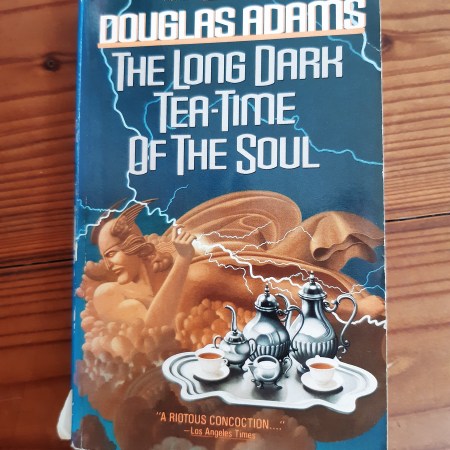
After watching a season of Dirk Gently’s Holistic Detective Agency on Netflix with the kids, I re-read Douglas Adams’ original books. I find them exceptionally funny, but also full of wisdom, especially in the realm of decision theory. In a short series of posts, I want to go through some fine examples of these.
On page 115 of my edition of “The long dark tea-time of the soul” we overhear a psychologist talking to a client over the phone. We only hear the psychologist’s side of the conversation.
“Yes, it is true that sometimes unusually intelligent and sensitive children can appear to be stupid. But, Mrs. Benson, stupid children can sometimes appear to be stupid as well. I think that’s something you might have to consider.”
A bit harsh, of course, but probably true. I especially like the repetition of “sometimes”. We understand what the psychologist is trying to say, of course. But, to make it probably unnecessarily clear, let me sketch a simple decision-theoretic model of the psychologist’s thinking. There is a true state of the world that the child is in: it is either unusually intelligent (UI) or stupid (S). Presumably, the child can also be something in between, but let me ignore this in my simple model. Observing the child for a bit provides us with some information, which can be described by what Blackwell would have called an information structure, or an experiment, or perhaps a signal-generating system. Ultimately, we obtain a signal. The signal is either that the child appears stupid (AS) or that it does not appear stupid (NAS). The probability that each signal is generated depends on the state. These probabilities are known to the expert psychologist. There is the probability that an unusually intelligent child appears stupid,
which, the psychologist admits, is positive (the first “sometimes” in the quote above). [In probability theory
is often referred to as the probability of appearing stupid (AS) conditional on the child being unusually intelligent.] And there is the probability that a stupid child appears stupid,
which, the psychologist claims, is also positive (the second “sometimes” in the above quote). Apparently, it may be less than one.
When the psychologist says that ”that’s something you have to consider” he means that you should compute the probability of the child being stupid, conditional on the child appearing stupid,
and that this depends also heavily on the probability that a stupid child appears stupid,
Formally, using Bayes’ law, we get that
Presumably, and the first word in “unusually intelligent” seems to suggest this, the ex-ante (or a priori as Bayesians like to say) probability of a child being unusually intelligent,
is low. This means that
is probably almost negligible in the calculation relative to
which would really suggest an ex-post (or a posteriori as Bayesians like to say) probability of a child being stupid when it appears stupid
to be definitely positive, if not even relatively close to one.
The psychologist ends the phone conversation with “I know it’s very painful, yes. Good day, Mrs. Benson.”
-
Innovative Strategies in Warfare

In C. S. Forester’s The Commodore, the main character Horatio Hornblower is in charge of a small squadron of ships of the (British) Royal Navy in the Baltic Sea. We are in the year 1812 and in the middle of the Napoleonic Wars. I am here interested in an episode in the book, in which Hornblower is assisting the Russians (who have just entered the war against Napoleon’s France) in their defense against the siege of Riga (which really happened).
One of the people in charge of the Russian defense in Riga (in the book, not in reality) is the Prussian officer Carl von Clausewitz. While he was probably not involved in the siege of Riga in real life, Clausewitz did leave the Prussian army (when it was part of the Napoleonic armies) in 1812 to support Russia against France. Clausewitz wrote a very influential treatise on warfare, mostly after the Napoleonic Wars, that emphasized strategic thinking. I find it quite interesting that Forester used Clausewitz as one of the main characters in the siege and through him we learn a lot about sieges.
A siege in the 18th and early 19th century seems to have been developed to the point where every part of it is predictable. Over the years, soldiers have learned (and been trained) how to behave in a siege so much so that, game theoretically speaking, equilibrium play has been reached. Even if both sides know exactly what the other side is (and will be) doing, they can only do what the other side expects them to do in return. There is no better strategy out there for either side. This is nicely described in the book. When Clausewitz and Hornblower overlook the siege from the gallery of a church, we are informed of (what are probably) Hornblower’s thoughts: “To a doctrinaire soldier a siege was an intellectual exercise. It was mathematically possible to calculate the rate of progress of the approaches and the destructible effect of the batteries, to predict every move and countermove in advance, and to foretell within an hour the moment of the final assault.”
So, what is the apparent equilibrium in a siege, then? Well, we should probably take a step back and briefly sketch the game we are talking about. First, the players. We are dealing with a war between two sides. Each side is, in reality, composed of a large group of individuals, but each group acts in a very coordinated manner as they all share the same goal (or are at least made to share the same goal). So, I feel it is safe to assume that there are simply two players: the besiegers and the besieged. It is also pretty clear what each side wants: the besiegers want to conquer Riga, the besieged want to avoid this from happening.
Ideally, from the besiegers’ point of view, they would just run up to Riga and claim it as theirs. But that is not a good strategy, as the besieged are protected by walls and guns and would just shoot the besiegers. So, instead, the besiegers start digging trenches and putting up “gabions”, something that “looked like a wall”, along these trenches. Such a protected trench is called a “sap”. The starting point of the sap is at a reasonably safe distance from the town’s guns. Then slowly the besiegers extend the sap forward along “parallels,” I guess, this means in a zigzag manner. While the besiegers slowly but persistently do this, the besieged shoot at them with their big guns. This shooting is rather ineffective, and they can apparently only damage the newest bit of the wall while it is erected. Hornblower at one point asks Clausewitz: “Why do your guns not stop the work on the sap?” to which Clausewitz replies: “They are trying, as you see. But a single gabion is not an easy target to hit at this range, and it is only the end which is vulnerable.” This sapping allows the besiegers to not only slowly come closer to the town walls, but to also bring up some of their big guns. As Clausewitz explains further: “And by the time the sap approaches within easy range their battery-fire will be silencing our guns.”
I expect that much of warfare has these very predictable aspects, especially if a war goes on for some time. And these predictable aspects can probably be well described by an equilibrium of an appropriate game between the two sides. Harder to understand using game theory (or anything else, really) are cases of innovative warfare. This is what Hornblower in all the books excels at, but you feel that these cases are rarer in real life. I once read that Hornblower is probably not modeled on any single real person in the British Royal Navy, but on many of them. One person can probably not come up with as many innovative strategies as Hornblower has throughout all the books. To be fair, most people probably didn’t even have the opportunity to do so.
In The Commodore, Hornblower, watching the siege operations alongside Clausewitz, is struggling to think how he could help with Riga’s defense. Clausewitz asks him at one point: “Can you not bring your ships up, sir? See how the water comes close to the works there. You could shoot them to pieces with your big guns.” But the problem was that the water there was way too shallow for Hornblower’s ships. Hornblower explains this to “an unsympathetic ear” and is frustrated by his inability to help. He walks around his cabin and is further frustrated by the restricted space, when suddenly, while just climbing over a rail, with “one leg in mid-air”, an “idea came to him”. [I quite like how Hornblower’s ideas come to him – it is very much like I (and many theorists, I believe) do research.] Hornblower realizes that there could be a way to lift his ships almost out of the water by attaching little loaded boats or barrels full of sand (or something like that) to the ship and then unloading them. He then has the two “bomb-ketches” in his squadron lifted in this way and brings them into action for a few hours to devastating effect on the sapping operation.
Hornblower’s novel strategy was something that the besiegers were clearly not even aware of as being possible. For the besiegers, this was, in Donald Rumsfeld’s terminology, an “unknown unknown”. Similar surprising moves have been made recently by the Ukraine bombing Russian bomber planes using a complex operation deep in Russia, and by Israel with the exploding pagers. In those two cases, the other side was most likely also not even aware of these possibilities. Having done this once, however, one would assume that this cannot easily be done again, as the other side, now being aware of such possibilities, can probably put preventative measures in place. In Hornblower’s case, the French react by bringing up a battery of guns towards the lifted ships within a few hours and keep them there for the remainder of the siege.
Interestingly, and that again, because of the highly predictable siege equilibrium, Clausewitz can precisely quantify that Hornblower’s innovative strategy has delayed the besiegers by no more than four days.
-
Predictable and Predictably Unpredictable Warfare

[Photo by Rafael Garcin on Unsplash]
In C. S. Forester’s Hornblower and the Hotspur, Horatio Hornblower is a captain of a three-masted sloop (one of the smaller ships at the time), the Hotspur, in the (British) Royal Navy. It is 1803 and there is a temporary peace, the peace of Amiens, during which the Hotspur is patrolling some parts of the coast of France. The episode I want to study begins with a French ship, the Loire, a frigate that is a good deal bigger than the Hotspur, leaving her anchorage in the direction of the Hotspur. Captain Hornblower correctly suspects (through an interesting series of what one could describe as Bayesian probabilistic inferences) that war has been declared and, given the size disadvantage, sets a course to avoid a confrontation.
This situation can now be described as a game between two players, the two ships (or their two captains), with opposing preferences: The Loire wants to catch up with the Hotspur, and the Hotspur wants to evade the Loire. To finalize our model, we need to specify the available strategies. These are all the different directions that the ships could go in, taking into account some geographical (and weather) constraints. From the goals that the two captains have, we can derive payoffs for any strategy combination. These are presumably so that the Loire always prefers to go in the same direction as the Hotspur, and the Hotspur prefers to go in any direction that is different from the direction the Loire takes. A more careful reading of the book suggests a secondary payoff-relevant concern. Given the possibility of something (exogenously, as we like to say) happening (such as bad weather or the sudden appearance of another (most likely British) ship), the Loire would probably like to catch up with the Hotspur as quickly as possible, while the Hotspur would like to delay such an event as much as possible. This is highly relevant in the present case, because it quickly emerges that the Loire is the (slightly) faster ship.
Having thus verbally fully described the game between the two ships, we can turn to the equilibrium analysis. Equilibrium play seems very plausible in this case for two reasons. One, the game is relatively simple, and two, this is not the first time in the history of naval warfare that one ship tries to catch another ship. Together, these two observations make it quite likely that each of the two captains of the two respective navies (from their training and their experience) has learned to behave optimally given the other captain’s behavior. In short, it seems likely that they have learned Nash equilibrium behavior.
It seems that, at least in the present case, the best course of action for the Hotspur and, thus, the Hotspur’s equilibrium behavior, assuming (correctly) that the Loire would follow wherever the Hotspur goes, is to sail into the wind. I don’t know that much about sailing, but I have been given to understand that you cannot sail directly into the wind. You can only sail at some (maximally acute) angle against the direction that the wind is coming from. The geographical realities in the present case are such that the two ships cannot go in the same direction against the wind for too long before they would run aground just off the coast. The escaping ship, therefore, has to occasionally “tack”, that is, to turn to move along the opposite (maximally) acute angle against the wind, thereby going into the wind in a zigzag fashion. In equilibrium and, indeed, also in the book, the Loire tacks whenever the Hotspur does to lose as little time as possible. This highly predictable behavior now goes on for quite some time. During this time the officers of the Hotspur make fairly precise and worrying predictions as to how long they have before the Loire catches them.
But then there is an interesting twist. Some small isolated low clouds appear just above the water. Noticing these, Hornblower decides to delay tacking his ship beyond what would otherwise be seen as optimal until the Hotspur is hidden by one of these clouds. When the Hotspur comes out of the cloud on the other tack, Hornblower realizes to his surprise that the Loire is also already on the other tack. Her captain has wisely predicted the Hotspur’s movements and has tacked at the same time as the Hotspur, thereby not losing any time at all. Hornblower tells himself that he will not use this trick again, and when a second cloud covers the Hotspur, he does indeed not tack; he does not even think about tacking, in fact. After coming out of this cloud, Hornblower finds that, again to his surprise, the Loire has tacked. Presumably, the captain of the Loire thought that the Hotspur would be tacking and did the same. But in this case, the Loire made a mistake and lost some valuable time.
The presence of the clouds has changed the nature of the game. Without the clouds, that is, with full visibility, the game is essentially a sequential move game. The Loire can simply observe what the Hotspur does and make her choice afterwards. This makes it easy for the Loire to match her action to that of the Hotspur, while making it impossible for the Hotspur to prevent that. With the clouds, the game is better described by a simultaneous move game. While one of the ships is hidden from view within a cloud, neither captain can see the other captain’s move. The game they are now playing is an instance of the so-called matching-pennies game. Both captains have two choices: they can tack or not tack. The captain of the Loire would like the two ships’ actions to match; Hornblower would like them to mismatch. This game also has a Nash equilibrium, but it is in what game theorists call “mixed” strategies: this means both captains choose randomly whether to tack or not. Given the description in the book about Hornblower’s thought process, it does not sound like he is actually randomizing. All that is really needed, however, is that the two players’ actions are unpredictable for their opponent. And it seems that Hornblower’s thought process was not exactly what the captain of the Loire thought it was (at least not in the second cloud instance). In any case, with just the two data points that we have (there being only two instances with clouds), we cannot reject that the two captains are playing the equilibrium of this game.
The game without clouds had an equilibrium in pure strategies, in which both players were able to predict each other’s moves precisely. The game with clouds also had an equilibrium, but in mixed strategies. In this case, the two captains should not expect to be able to fully predict their opponent’s choice, but they should be able to predict the extent of unpredictability. They should know that there is essentially a 50-50 chance of either move and, therefore, should never really be super-surprised by anything the other captain does.
Donald Rumsfeld, as US Secretary of Defense, once puzzled the world a bit with a statement about the differences between “known knowns”, “known unknowns”, and “unknown unknowns”. One can give a purely decision-theoretic discussion of this statement, but one can also see this in game-theoretic terms. In the equilibrium of the game without clouds, every future move is known to the two captains. In the game with clouds, the captains (should) know that they don’t quite know their opponent’s next move (in the cloud). In another blog post, I will use another Hornblower story to discuss situations in which players don’t even know what they don’t know.
-
Electing the pope
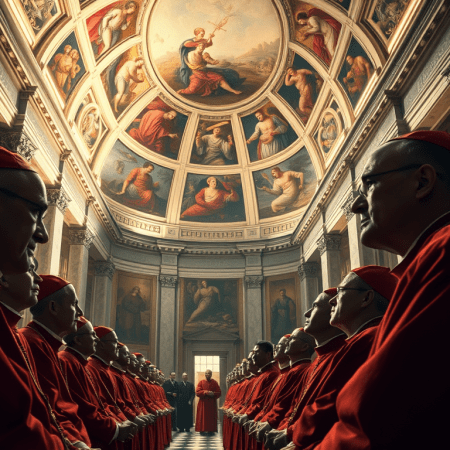
A new pope will be chosen in the papal conclave starting Wednesday 7 May 2025. Omitting some (I believe irrelevant) details, the procedure is roughly as follows: All cardinals under 80, who are well enough to do so, go in conclave at the Sistine Chapel at the Vatican and proceed to each individually and anonymously nominate (vote for) a person to be pope in a series of scrutinies (rounds) until one “candidate” has more than two-thirds of all votes. This person is then the new pope.
Between reading Robert Harris’ “Conclave” and hearing (Nobel Laureate) Eric Maskin’s recent Schumpeter lectures on the “Theory of Voting,” I consider myself in a good position, if not to analyze fully, but to at least provide some reasonably informed discussion of the papal voting procedure. The exact voting procedure used for electing popes has not been studied much yet. For a good starting point, you might look at the recent paper by Andrew Mackenzie and some of the references therein, but my “treatment” here is a bit different. I will put more focus on the role of communication throughout the multiple rounds of voting.
While I do want to get to analyzing the particular voting procedure used to elect the pope as quickly as possible, I think it is helpful to establish a bit more general voting theory context. First, Eric Maskin’s lectures (based on his recent paper) have convinced me (to see why see my earlier blog post on how a book club should choose which book to read next) that there is a best voting rule if voters can be assumed to vote sincerely. To vote sincerely means to provide your true preferences: You don’t try to strategically manipulate the election outcome in your favor by misrepresenting your preferences. This best rule is the (more than 200-year-old) Borda rule (or Borda count). It works as follows. Suppose there are n candidates to choose from (in practice these are all the cardinals, but, in theory, they could be all catholic men – the last pope that was not a cardinal was Pope Urban VI in the 14th century). Then every cardinal at the conclave provides a full ranking of all the possible candidates. This ranking translates into points: the top-ranked candidate gets n points, the next best-ranked candidate gets n-1 points, and so on down the ranking, until the least-ranked candidate gets 1 point. These points are then summed up and the candidate with the highest number of points is the pope. If there is more than one candidate with this highest point total, then the holy ghost decides by means of a throw of a coin or dice or something like that.
While reading this, you immediately have one counterargument to this procedure in that it seems impossible to provide a full ranking over all candidates (especially when we consider all catholic men), but one could probably allow a cutoff under which the cardinals don’t have to rank candidates any further. If there is sufficient agreement among the electing cardinals as to a small set of possible suitable candidates, then this should be possible and sufficient.
A bigger problem with the Borda rule is that it is strategically manipulable. Let me first explain why and then discuss whether we think this is a problem – after all, cardinals swear this oath: “I call as my witness Christ the Lord who will be my judge, that my vote is given to the one who before God I think should be elected.’’ I have this from page 719 of the paper by Andrew Mackenzie, who has this from reliable sources and something along these lines is also repeatedly stated in Robert Harris’ novel.
How is the Borda rule strategically manipulable? Suppose, for instance, that there are only three serious candidates, A, B, and C. Suppose that just more than one half of all cardinals prefer A over B over C (the “A supporters”) and the remaining (just under a half of all) cardinals prefer B over A over C (the “B supporters”). If they all provide their true ranking, candidate A will be pope by the Borda count. Now, suppose that the B supporters suspect that this is the situation. Then, if (at least a sufficiently large fraction of) the B supporters get together and strategically declare their preference as B over C over A (instead of B over A over C), then their favorite candidate B would win by the Borda count. Thus, by strategically misrepresenting their preferences, they would get their favorite candidate, B, to win.
Would the cardinals do that? It all depends on how the B supporters interpret “that my vote is given to the one who before God I think should be elected.” I think it is not hard for them to rationalize to themselves that when they think about it, they actually do prefer C over A even if this is not really so. Or they could be pragmatic and read this line as to mean that they should do everything in their power to have that candidate elected that they truly think is best. We will come back to this point.
In any case, given that the Borda rule is strategically manipulable, maybe it should not be used in such a context. And, of course, it is not used to elect the pope. But the problem is that no voting rule is non-manipulable (unless it is dictatorial – meaning that one person decides who is pope). This is the essence of the Gibbard-Satterthwaite theorem. But is strategic manipulation always bad? In fact, I have the feeling that the papal voting procedure does a pretty good job of utilizing strategic “manipulation” in such a way that the pope is always a pretty good (compromise) choice.
At the start of the conclave there seem to me to be three kinds of uncertainties that the voting cardinals have. First, they probably don’t all know each other very well: some cardinals might not fully know another cardinal’s “qualities” and also not know their points of view on the many policy issues they care about. Second, even if a cardinal knows every other cardinal’s views, they don’t necessarily know every other cardinal’s preferences over which cardinal should be elected pope. Third, and finally, even if a cardinal knows every other cardinal’s preferences, this does not immediately mean they know which pope every other cardinal would (strategically) vote for.
It seems clear to me that having time and communication helps with all three types of uncertainties. If there would be just one round of (even Borda rule) voting, then whoever wins may be the best only according to the partial information the voting cardinals have. This is nicely and very plausibly demonstrated in Robert Harris’ novel when new information appears (and spreads) at the conclave about two of the front runners (Adeyemi and Tremblay). Each of them was almost elected, but that would have been a very bad choice in hindsight – as each had made some (at least according to the Church) bad mistakes in the past that would not be acceptable in a pope.
So having a bit more time helps to have this information spread around and having some early rounds of voting (with no real expectation of electing a pope just yet) helps identify the front runners and, thus, focuses the communication on the relevant individuals. Having multiple rounds of voting also seems essential to me to solve the third problem of strategic uncertainty.
To see this, consider the following situation. Suppose that there are only three candidates (A, B, and C) in the running and the voting cardinals either have preferences A over B over C, B over A over C, and C over A and B (with A and B more or less equal) with say roughly 30% of the cardinals with the first preference and another 30% with the second, and about 40% with the third. If you have read Harris’ novel you can think of A as Bellini, B as Lomeli, and C as Tedesco (A and B are liberals, and C is a traditionalist). At one point in the novel, Tedesco tells Lomeli that he thinks it’s good that Lomeli is getting votes, thereby splitting the liberal vote. One can think of the first round of voting more of an opinion poll rather than a vote as it is almost impossible that it will result in a two-thirds majority for any one candidate. Suppose that cardinals in the first round simply vote according to their preferences. Then we would see roughly 30% voting for A, roughly another 30% for B, and roughly 40% for C. If we had plurality rule (meaning the candidate with the highest number of votes wins) C would be pope. But now, one can imagine that the A and B supporters (who all dislike C) would rethink their choices. Suppose that B had slightly more votes than A. Then it seems plausible that the A voters (the least chosen in the first round) now start voting for B. If eventually all of them do, then B will get roughly 60%, while C remains at 40%. By the way, this is roughly what seems to happen in Harris’ novel. At least the main character, cardinal Lomeli, whose thoughts we know best, occasionally switches his votes from candidates that seem to have no more chance to his next favorite. He starts with voting for Bellini, and when Bellini no longer seems to have a chance, then to Tremblay, then eventually to Benitez. There is an interesting dialogue between cardinals Lomeli and Bellini, in which Lomeli says that he has to keep voting for Bellini as Bellini is his true most preferred pope and in which Lomeli refers to the above oath as justification. To this Bellini says that this is nonsense and not how this oath should be interpreted, otherwise no pope would ever be elected (or some such words).
In any case, one can show that the behavior I have just described is a (certain kind of) empirically plausible Nash equilibrium in this simple voting game with just the three candidates as Costel Andonie and I have shown in a paper not too long ago. There is also some empirical evidence from lab experiments by Forsythe, Myerson, Rietz, and Weber in their 1993 paper that people behave in this way and an (admittedly but necessarily somewhat complicated) theoretical analysis of why they do so in a paper I wrote with Daniel Rodenburger. These papers only deal with this special setting with only three candidates and I am not aware of any papers that have tried to extend this approach. Nevertheless, I do think that they provide a bit of a justification for the papal voting procedure, in which multiple rounds of voting induce strategic manipulation that, however, ultimately provides a pretty good (compromise) outcome. Note that in the case with three candidates described above the (equilibrium) behavior also described above leads to the Borda rule choice!
Finally, why the conclave? In my three-candidate example above, the vote will soon be at roughly 60% for B and roughly 40% for C. We could now be stuck here forever. But two thoughts will now go through the voting cardinals’ minds (both mentioned in Robert Harris’ novel): for their own personal comfort they don’t want to be in conclave forever and also for the sake of the reputation of the church and the new pope they want the election over after not too many days of conclave. This gives the cardinals an incentive to switch from C to B (even if this seems to violate their oath yet again), so that finally a new pope is eventually elected.
-
A book club choosing the next book to read

Some little time ago, my mother-in-law asked me if I knew of a good way for her book club to decide which book to read next. The problem is this. Usually, various members make suggestions and so there is a longish list of possible books they could choose. However, there is typically cordial disagreement among the members of the book club as to which book they should choose. Ultimately, a single choice has to be made, but how? My mother-in-law wasn’t happy with the voting procedure that her book club was using, but she was also not sure what better procedure she could suggest. So, she asked me. My response to her at the time was not very satisfying. I told her that there is something called Arrow’s impossibility theorem that states that it is impossible to come up with a good voting procedure for such problems. This didn’t help her very much. In the meantime, however, I have had the benefit of hearing (the 2007 Nobel Laureate in Economics) Eric Maskin talk about this very issue (in the 2025 Schumpeter Lectures at the University Graz), based on a recent paper. And now I know.
For the impatient reader, let me give you the answer right away. The book club should use the Borda rule or Borda count. It is very simple. Suppose there are n books on the list. Then every member of the book club declares their full preferences over all the books on the list. In other words, they each state their ranking from the top-ranked all the way down to the bottom-ranked book. This ranking translates into points: the top-ranked book gets n points, the next best-ranked book gets n-1 points, and so on down the ranking, until the least-ranked book gets 1 point. These points are then summed up over all the members’ rankings and the book with the highest point total is chosen. If two or more books have the same point total, you could flip a coin (or roll dice) to pick one among these.
The Borda count was suggested by Jean-Charles de Borda a bit more than 250 years ago and probably already earlier by others. So why do we know only now that it really should be used? This is because of a new insight provided by Eric Maskin, building on an earlier insight by Donald Saari.
We have to begin with Arrow’s impossibility theorem. We are interested in translating (or mapping) the set of individual rankings members have over the books to one collective (or societal) ranking (or at least one collective top choice) when there are at least three alternatives (three books in our case). And, because we don’t ex ante know each member’s preferences, we would like this mapping to identify a collective choice for all possible sets of individual rankings. Arrow imposed three conditions such a mapping should satisfy. It should satisfy the Pareto property: if everyone agrees that book A is ranked above book B, then the societal ranking should also rank A above B. It should also satisfy the no-dictatorship property: the societal ranking should not always coincide (regardless of what preferences the members have) with one and the same member’s ranking. If it did, this would mean that, no matter what preferences everyone has, the societal choice is decided by the one member, who we would then call the dictator. These two properties seem very non-controversial: we wouldn’t call it a collective or societal choice if only one person decides what is chosen; and why would we ever want to choose book B, when everyone prefers A over B? But there is a third property Arrow demanded, the independence of irrelevant alternatives: the societal ranking of any two books A and B should only depend on how the members rank books A versus B. It should not depend on how members evaluate those books relative to any other book C. This also seems quite reasonable. After all, we are talking about comparing A and B. So why would book C suddenly come in?
Unfortunately, though, and this is Arrow’s impossibility theorem, there is no mapping translating individual rankings to a societal ranking that satisfies all three properties. I will not give you the proof, but you can find a couple of proofs here. I will here only explain why the Borda rule does not satisfy all the properties we wanted. It clearly satisfies no-dictatorship and the Pareto property, but it does not satisfy the independence of irrelevant alternatives. To see this, we can use an example with only two book club members and three books. Suppose member 1 ranks A over B over C and member 2 ranks B over A over C. Their rankings are also given in the following table (the ones headed by 1 and 2).
Then the Borda count method would result in a tie between books A and B and a coin flip would decide which one is chosen. Now suppose person 2 had different preferences after all: say she ranks books B over C over A (as in 2-alt in the above table). In this case the Borda count makes B the unique winner, even though we did not change how the two members compare books A and B. Only the place of C has changed for one member. If you don’t like that there is a coin-toss involved you can also construct an example with four books and two members that does not involve a tie. [Member 1 ranks A over B over C over D, and member 2 either C over A over D over B or C over D over B over A. In the first case A is chosen and in the second C, even though member 2 ranks C over A in both cases.]
Donald Saari (see Theorem 6 in this article, which goes back to a book by Saari in 1995) may have been the first to realize that the Borda rule, however, satisfies a slightly less demanding version of the independence of irrelevant alternatives. Eric Maskin calls it the modified independence of irrelevant alternatives property. It states that the societal ranking of book A versus book B should only be affected by how individuals compare books A and B and by how many other books they rank in between the two. The Borda rule satisfies this modified independence of irrelevant alternatives property. If you fix the number of books that members rank between books A and B then their point difference from each member’s points is the same and, thus, their total point difference, and their societal ranking, remains the same as well.
Eric Maskin then showed that there is a sense in which the Borda rule is the only reasonable rule that satisfies the modified independence of irrelevant alternatives property. This result is a bit more complicated but let me try to, at least, state it correctly. First, we demand a bit more fairness than just the no-dictatorship property. To do so we take some properties that May has suggested (to argue that majority rule voting is best when there are only two alternatives). We demand that the societal ranking is ex-ante fair in terms of books and members. The societal ranking should not favor one book over another just because of its title. Mathematically, this can be achieved by saying that if we permute the book titles without affecting the members’ preferences, then ultimately the societal ranking should stay the same (now with the new titles). This property is called neutrality. Similarly, the societal ranking should not favor any particular member. This can be achieved by requiring that if we fix the set of members’ preferences, but change who has which of these preferences, then the societal ranking stays the same. This property is called anonymity. We then demand one last property, called positive responsiveness. If book A moves up in some members’ ranking and doesn’t move down in any member’s ranking then A should move up in the societal ranking (at least in some cases). Ok, this is a bit vague and you will have to read the paper for the full definition. Eric Maskin then showed that the Borda rule is the only rule that satisfies the modified independence of alternatives, neutrality, anonymity, positive responsiveness, and (a weaker version of) the Pareto property. So, that’s why every book club should use the Borda count.
Now, if you are still reading at this point, I have to mention a caveat to what I have just said. Unfortunately, the Borda rule is strategically manipulable. In other words, members of the book club could (in some cases) strategically misrepresent their preferences to get their most preferred book chosen, even if it would not have been chosen if everyone were truthful. To see this, consider again the book club with just two members and three books as we already had above. Consider again the case that member 1 ranks A over B over C and member 2 ranks B over A over C. The Borda count method would result in a tie between books A and B and a coin flip would decide which one is chosen. Now suppose that member 2 has a strong suspicion that member 1’s ranking is A over B over C. In that case, member 2 could make her favorite book, book B, the sole winner by pretending to rank C higher than A, that is, she submits the false ranking B over C over A. [You could do a similar exercise with the four-book example that does not involve ties.] We can also see that strategic non-manipulability has something to do with the independence of irrelevant alternatives. Indeed, there is another impossibility theorem, the Gibbard-Satterthwaite theorem, which states that if there are three or more alternatives then there is no collective choice mapping (translating individual rankings to a societal ranking) that is strategy-proof (non-manipulable) and non-dictatorial.
Because it is strategically manipulable one would not generally advocate the Borda rule for all collective decision problems, such as important political issues. [Although Eric Maskin also had a solution for those problems (which I may write about in another post).] But this is also (apart from my mother-in-law asking me about this) why I wrote about book clubs here. In a book club, one could probably appeal to the honesty and integrity of its members to refrain from strategic manipulation and then the Borda rule stands out as probably the single best rule for collectively choosing which book to read next.
-
Why happiness is elusive

There is an Austrian saying that “happiness is a bird” (“Das Glück is a Vogerl”). The idea, I think, is that happiness is hard to catch and even harder to keep hold of. In this blog post, I want to offer a formal model and definition of happiness that is able to generate the fleeting nature of happiness.
First, a bit of casual introspection to set the stage for modeling ideas. Imagine that sometime around early winter you finalize your summer holiday plans. You are planning a road trip through Australia (in their winter and your summer), something you are very excited about. Imagine that a month later – still (your) winter – you learn that something happened that is not a big problem in itself, but that will prevent you from going to Australia after all. Say, it turns out you can’t take that particular time off after all, but that is the only time that would have worked for the other people you were planning to go with on this trip. You will probably be very unhappy. And you will be unhappy right then and there, in (your) winter, months before you were supposed to be going on this trip. You don’t wait to be unhappy until the summer comes along. In fact, when the summer does come along, you will probably already be less unhappy, you have already “worked through” your grief.
The key element that I want to take up from this casual introspection is that humans are very forward-looking. They create expectations of the future and, in a sense, “consume” at least part of their future expectations before these are realized. And, as I will argue, humans who are good at forming correct expectations will likely only be happy for short amounts of time. They will not be able to live in a permanent state of bliss. [On the flip side they will also only be unhappy for short amounts of time.]
One way to see things is that there are many possible paths that your life could take. You control some aspects of which path you get, but no matter how much you control things, how much you “take life into your own hands,” there is always some leftover uncertainty. In fact, there is probably a lot of leftover uncertainty. You make educational choices, you decide what to study, and you decide which jobs you apply for, but what job you end up getting and where is not only up to you. You make friends and have a family, but who exactly they are and what happens to them, something you also care about, is again not all down to you.
Turning to a mathematical description of your life, we can collect all possible paths of life that could happen to you in one big set
At the beginning of your life, you have a belief about the likelihood of these various possible paths, which we capture by a probability distribution over
Here, I am not sure whether what I propose is the best way to model this – I am following standard models of intertemporal choice in economics and I haven’t thought deeply enough about possibly better alternatives. The idea is that a path in life
gives you a level of instantaneous satisfaction at any moment of time
I will, for simplicity, count time discretely in, say, days. A path
would then give you a sequence of instantaneous levels of satisfaction for all days, from day zero (now) until the end of days. Call these levels of satisfaction
I am using
because in economic models this is what you often see, with
for every moment of your life
for some discount factor
Note that you can potentially live forever here. However, we can interpret the so-called discount factor
as at least partly reflecting your less-than-certain chance of surviving until the next day. In that case, even if you could live forever in theory, the chances of that happening are zero. The discount factor can partly also reflect your degree of impatience.
So, we have formalized the possible paths of life and their consequences for us in terms of lifetime satisfaction. I have not yet mentioned happiness. And happiness will not be the same as lifetime satisfaction. I guess this is a bit controversial, but I believe that happiness is what we experience when things turn out better than expected. And we are unhappy when things turn out worse than we expected. To capture this, we introduce events – things that can happen to us. One way to see this is that, as time goes on, we can rule out more and more paths in life. This can be captured by a stochastic process that is a filtration. It has the property that whatever you know to be true at time
you also know to be true at time
You don’t forget and you may learn new things. Suppose we call
the information (about your path in life) that you have received up to and including time
I can now finally define your happiness as the difference between your “updated” expected time-t lifetime satisfaction and your “original” expected time-t lifetime satisfaction. Formally, happiness is given by
I should probably cite some literature now that justifies my definition of happiness. The best I can do is to point you to the work of Arthur Robson on the biological basis of human (economic) behavior. I am not sure he would quite agree with my model here, but it is partly based on my, possibly imperfect, reading of his work. I came to the belief that happiness is not the same as lifetime satisfaction and that mother nature uses our pursuit of happiness (through the clever use of short-lived dopamine bursts) not to make us happy but to make us always want to achieve more and more and more – ever to increase our evolutionary fitness. Given mother nature’s biological constraints, she chose to make happiness have less to do with the level of lifetime satisfaction but with how it changes when certain events happen to you.
If happiness is given like this, continued happiness (undermining mother nature’s goals) would be best achieved by maintaining low expectations. Sage advice I would think, but hard to follow. Ideally, you would never expect a good meal and always be surprised when you get one. “Oh boy, I am getting something nice for breakfast!” This is difficult to keep up when you get a good breakfast every day. But it would quite possibly be a happier life.
When I lived in Chicago, I flew back to Austria to see family about twice a year. I collected air miles and fairly soon had a good stash thereof. I don’t know if it was a glitch in the airline’s system, but when just before boarding I asked for an upgrade based on my air miles, I often got one without the airline ever taking any miles off my account. I kept getting upgraded. The first time this happened to me I was extremely happy. It was one of the best flight experiences I ever had. This is so, I believe, because it came as a surprise – I did not expect to be upgraded. But after a while, the experience became more routine and did not give me that much happiness. I came to expect an upgrade. When I then did not get one, I was pretty unhappy. I was, in fact, much less happy than in the earlier days when I was never upgraded and never expected to be upgraded.
My kids form high expectations almost too easily. We had ice cream after lunch one Friday, and happened to have ice cream after lunch on the following Friday as well. When the kids didn’t get ice cream after lunch on the next Friday, they were unhappy and were asking us “what happened to Friday ice cream?”
Of course, I have described only one aspect of happiness. I am, for instance, ignoring things like clinical depression, which I would find harder to model and even harder to explain. I am also ignoring happiness that stems from achieving something. For instance, I would value the view on a mountain peak very differently depending on how I got to this peak. I believe I would get much more “out of” the view at the peak if it came as a reward at the end of a long and challenging hike rather than being the result of being dropped off by a helicopter. All I wanted to offer in this post was a formal model that can generate the fleeting nature of happiness, at least as I perceive it. But there is a lot more that could be said about the strange nature of human happiness.
-
Giving tenure to researchers on non-tenure track positions

At Austrian universities, many (young) researchers are employed on fixed-term contracts without a clearly specified path to tenure (a permanent position). Young researchers on such fixed-term contracts are rightly worried about their future and would, of course, love to get permanent contracts. Some time ago the Austrian minister for Education, Science, and Research publicly said that universities should consider giving tenure to a substantial number of researchers currently on fixed-term contracts. I don’t think that this is a good idea. To be more specific, I believe that there is a much better way of giving young researchers long-term career perspectives: The universities should offer more tenure-track positions, perhaps, as I have seen in the USA and my field of economics, even for researchers who have just finished their doctoral studies.
At first glance you might say that this is exactly what the minister said. Surely, there is not much difference between giving people fixed-term contracts and then giving some of them tenure after all and giving them tenure-track positions from the start. But there is a huge difference. The difference can be explained with two notions from economics: adverse selection and moral hazard.
Let me first explain the adverse selection problem. Put yourself in the shoes of a promising young researcher (somewhere in the world) who has just finished their PhD and is now looking for a job. They are looking through the job adverts and find two categories of jobs: fixed-term positions (without any apparent possibility of being tenured) and tenure-track positions. Which would they prefer? Of course, there are other considerations, such as salary, the quality and quantity of the group of researchers at this place, the location, and so on. But I would conjecture that for many, ceteris paribus as economists like to say, tenure-track beats fixed-term by a large margin. Considering this problem from the point of view of the university, this means that by offering fixed-term positions when others offer tenure-track positions, the university will probably, on average, not receive the best applicants for these jobs. If the university then ultimately and surprisingly gives tenure to some of the fixed-term employed researchers, the university is likely not giving the job to the best people they could have found if they had offered tenure-track positions to begin with. This is the adverse selection problem.
In addition, there is also the moral hazard problem. Now put yourself in the shoes of a (young) researcher employed in a fixed-term position who is told there may be a chance to get tenure after all. You would ask yourself and your boss(es) what you should do to improve your chances of this. I suspect that, without clearly pre-specified criteria for getting tenure, it is down to this (young) researcher’s boss to lobby the higher university authorities for the (young) researcher to get tenure. Would your boss use the same (unstated) criteria that a (universally, or at least within the university) agreed and publicly communicated tenure-track contract would specify? Not necessarily. I would conjecture that some bosses would favor pushing those young researchers who help their bosses rather than those who do great independent research. As a young researcher, hoping that your boss will lobby for you to get tenure, what would you do if this boss asks you to jump in to teach their class tomorrow or to replace them at a meeting and to keep notes for them? Well, you would probably do it. A pre-specified catalog of achievements and obligations necessary for getting tenure will, however, likely not have such items on their list. I have a strong feeling that many (young) researchers in fixed-term positions who hope to be given tenure after all, end up wasting valuable time on for them and for science on the whole irrelevant things.
In short, I have argued that giving tenure to researchers on non-tenure track positions entails an adverse selection problem and a moral hazard problem. The effect of this is that the university ultimately does not hire the best researchers they could have hired, and these researchers do lots of work that has little to do with excellent research per se.


-
Subscribe
Subscribed
Already have a WordPress.com account? Log in now.
 The Game Theory of Everyday Life