This summer we watched “The Odyssey” in the cinema. It is full of game-theoretically interesting bits. One can, for instance, see the societal norms around “Zeus’ law” (or xenia) as an (apparently somewhat fragile) equilibrium of a somewhat complex repeated (or stochastic) game. This “law” is a societal norm that people should be kind to travelling guests, they should give them shelter and food, a bath, even gifts. Guests are also supposed to be well-behaved at least, but most of the burden is clearly on the hosts’ side. The “law” is not backed up by a combination of police work and law courts detecting and punishing violations of the law. But then why do people adhere to it? There is a game-theoretic literature that shows that social norms such as the ancient Greek’s xenia can be self-enforcing, that is these norms can be seen as the outcome of equilibrium behavior in the complex game: given that everyone follows the law, it is in every individual’s interest to adhere to the law as well. This literature starts, I believe, with Michihiro Kandori’s 1992 “Social norms and community enforcement”, and is ongoing, see a 2022 survey by Alexander Wolitzki “Cooperation in large societies.” I have described something like it, in its perhaps simplest form, in another blog post (on behavior in public places with a short model).
The idea in the context of xenia is that people follow the norm of being nice to their guests that they are hosting, because they themselves will eventually travel and will also want to benefit from the norm. They worry that if they stopped being nice to their guests, news of their misbehavior will eventually spread and either they will personally not be allowed to benefit from the norm (their host will recognize them or know about their by then bad reputation) or the whole norm will collapse because those who have been treated unkindly by the host, in turn start treating their guests badly and then their guests start treating their guests badly and so on. Kandori’s work and follow up research shows that such a strategy (here the adherence to Zeus’ law) with its implicit threats of what would happen if someone deviates can be a (subgame perfect) equilibrium of the complex game. [Subgame perfect means that all threats involved in the equilibrium are credible in that they in themselves also constitute equilibrium behavior.]
One of the most well-known parts of the Odyssey is Odysseus’ tying himself to the mast of his ship so that he can listen to the songs of the sirens, but without the terrible consequences (of falling into their trap). Odysseus’ behavior is an often-used metaphor (even in the decision-theoretic literature) for the desire for and power of commitment. This could be seen as a game between two versions of one person: the current self and the future self. The current self may want to restrict their own future self’s options, knowing that the future self may otherwise make choices that the current self disagrees with. A sugar “addict”, for instance (using a more moderate example), might deliberately avoid having sweets at home, even if they would like to eat a small amount now and then, which their current self would actually find acceptable. But the current self avoids buying sweets to prevent their (not too distant) future self from binge eating them in one go.
Then there is the costly signaling game that the gods seem to be playing with people, when they require them to make costly sacrifices in order to grant them something in return. Agamemnon sacrificed his own child – an incredibly costly signal one would think – just for favorable winds to sail to Troy. Ultimately this gave Agamemnon not only pain, but also led to his death – he is killed by his revenging wife after he gets home from Troy. I believe that if we think this game through properly, it will reveal that what gods want most is to be believed in and that they demand total loyalty on top of that. Rather mean, I feel. Why can’t they grant wishes just like that?
But I here want to take up the recurring prophecies in the old Greek myths. Odysseus is involved in at least two, one about Achilles, and one, part of the movie’s plot, about himself by the seer Tiresias (in the original, the prophecy that I mean seems to have been made by Circe). Almost all prophecies in Greek mythology ultimately come true. One can read this as being a statement about the inescapable power of fate. The seers have the ability to see the future, and because it is the future, what they see will become true.
To my game-theoretic eyes, however, at least some of these prophecies can be seen as an equilibrium selection procedure, with the seer through their prophecies choosing one among many possible equilibria of the game of life that the people are involved in.
The prophecies in the Odyssey sometimes leave the actors with a choice between different possible futures. I’d here like to consider a more extreme example from Greek mythology, the prophecy that Oedipus will kill his father and marry his mother. I believe that this prophecy only came true because it was (publicly – to all relevant people concerned) made. Because the prophecy was made, and only because of that, Oedipus’ parents left him to die on a mountain. Oedipus is found and raised by different people. Oedipus eventually learns about the prophecy, and, believing his adopted parents to be his real parents, leaves them to avoid the prophecy. Leaving them, he encounters first his real father, who he kills, not knowing that he is his real father, then as a reward for something marries the queen, his real mother, with Oedipus again not knowing this fact. So, yes, one can read this as fate being so inescapable that even all these drastic measures cannot prevent it from happening. But I feel, that if the prophecy had never been made, the “game” could easily have been played out to another equilibrium, in which Oedipus would neither have killed his father nor married his mother. I feel the announcement of the prophecy has directly led to it becoming true: a self-fulfilling prophecy, which can be understood as the outcome of an equilibrium in a game that also includes the seer.
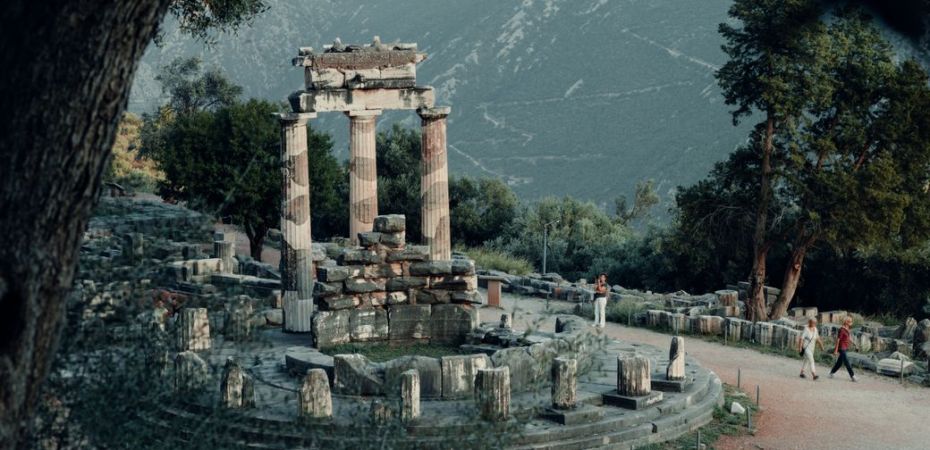
Let me look at the prophecy from the point of view of the seer, here the Oracle of Delphi. The oracle’s primary goal, one would think, is to make a prophecy that ultimately comes true. But this requires more than foreknowledge of the future. She also has to take into account that people who hear about the prophecy might react to the content of the prophecy. And that they do so is very clear in Oedipus’ case. So, the oracle has to consider all possible statements she could make and think through what the people’s reactions to that statement would be. Then she has to pick a statement that, taking all reactions into account, makes the statement come true. It is of course possible that there are multiple distinct statements that she could have made that have this feature. For instance, she could probably have also said that Oedipus throughout his long life will always cherish and look after his parents. A bit boring but possibly also self-fulfilling. I don’t quite know why she chose the prophecy that she made, but maybe she has a secondary goal that she wants to make drastic prophecies for advertising reasons. In any case, in game-theoretic terms, the oracle makes a statement that together with the people’s reactions to it form a Nash equilibrium of the induced game of life between all these actors. [By the way for macroeconomists there is a close connection to the Lucas critique.]
There are more modern counterparts to the ancient Greek prophecies. Public statements (such as forecasts about GDP, for instance) by central banks, for instance, will probably have many people reacting to them. And if they want the forecast to “come true” they better take these reactions into account. Even more mundane, Google maps might have the power to choose driving equilibria, assuming (almost) everyone uses it as a driving guide. They should, for instance, probably realize that if they say that one road will be heavily congested (because of road works or something like that), any alternative route will probably also become congested because people now try to avoid the congested road.
I particularly like a scene in “The Matrix” movie that I have just rewatched with the kids. It also has an “oracle”. In the scene, this oracle tells Neo not to worry about the vase. Neo is a bit confused as he does not recollect having done anything to a vase. In his slight confusion he turns to look around, thereby breaking the vase that stands next to him as he now sees. The oracle then says that Neo will later wonder if he only broke the vase because she had said what she had said. Very similarly to the Oedipus case, I feel, the oracle did more than predict the future, she influenced it by picking one among several possible equilibria of the game they are all involved in.

