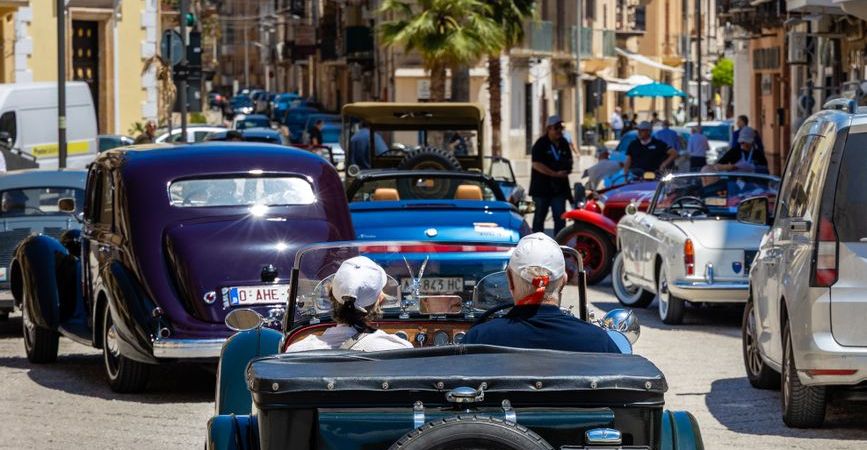
Last summer we spent a week in the south of France. To get there, we drove from Graz through parts of Austria, Italy, and France. We drove casually (if that’s the word I want) and took three days to get there. As I spent a lot of time driving to get to our destination, I had plenty of opportunities to study the different driving norms in different parts of Europe. For me, a norm of behavior is really an equilibrium of some game. When there are two different norms in two different places for more or less the same societal problem, then the underlying game simply has multiple equilibria, and different equilibria are played in different regions. [This is, by the way, very consistent with the view of the micro-sociologist Erving Goffman, as I have pointed out already elsewhere.]
But this means that when you go from one region to another and the norms change, you should probably change your behavior yourself. And driving makes this clearer than almost anything else. When I drive in Austria, I more or less observe the speed limits pretty closely. Most people in Austria do. So when, for instance, there are roadworks on a highway and the speed limit goes down from 130 to 100, or to 80 km/h, I, like most others (not all, of course), follow the implicit instructions. I do so for a variety of reasons. There are occasional speed cameras, and if they catch you speeding, you pay a hefty fine. If you speed, other drivers might get annoyed at you – this can be expressed in different ways and can be detrimental to your wellbeing. Also, there typically is a reason for slower speeds – narrower lanes, lanes coming together, or construction traffic – and you are safer if you slow down. All in all, I have decided that following the speed limits in Austria is approximately in my own best interest.
When I was driving on Italian highways, things were clearly different. Let me sketch one of the more extreme examples in some detail. The current speed limit is 100 km/h. There are three lanes in one and the same direction, and there is a lot of traffic. I am in the middle lane. Everyone, in all three lanes, is going about 100 km/h or slightly faster. The cars in the leftmost lane go even a bit faster. Then there are roadworks, and the speed limit suddenly goes down to 40 km/h. And nobody slows down at all. So, of course, I also do not slow down. Now, I later asked ChatGPT out of curiosity what I should do in such a situation, and even ChatGPT said that I should definitely not slow down to 40 km/h. It is just not safe. ChatGPT recommended that I should perhaps try at least not to be the fastest of all the cars and stay in the middle lane, but otherwise I should go with the flow of traffic. Even if there were potential fines for speeding (if I was caught), the loss to my wellbeing due to the induced risk of death or the implications of an accident when slowing down is just much greater than any estimated expected fine I would possibly get. I also feel that it would be difficult to argue that they should even fine me when many other cars were going much faster. So, I believe it is in my interest to do what I did and, like everyone else, not slow down. And if it is in my interest not to slow down, it is also in everyone else’s interest not to slow down. By the way, the moment we entered France, most people immediately observed all the speed limits again.
In other words, when you move to a place with a different norm, you should probably do what the proverb suggests: “When in Rome, do as the Romans do.” According to Wikipedia, the proverb goes back to some advice that Saint Ambrose gave to Saint Monica and her son, Saint Augustine, at some point in the 4th century (before they were all saints, I suppose). In Rome (where they were going), Saturday is a fast day, while in Milan (where they lived), it is not. Saint Ambrose said that they should follow the norms in Rome and, when they were there, they should fast on Saturday.
It may not always be so easy to follow the local norm. Staying with the example of driving, consider driving in Sicily. Suppose you come up to an intersection and your traffic light is red. While in most places, even in northern Italy, this means that you should stop and wait until you get a green light, this is not so in Sicily. [At least it was not so last time I drove in Sicily (which admittedly is quite some time ago) and I understand that at least remnants of this behavior are still there today. Also definitely in some parts of Turkey I have been told.] If you do stop, you get honked at by the people behind you. You get honked at more and more aggressively if you don’t start moving into the intersection. In Sicily, legally, a red light is of course the same as in northern Italy, but local norms have it more as a suggestion than a requirement. And it is not only up to you to decide whether you follow the suggestion. Drivers in Sicily would slow down when they see a red light, yes, but then they would carefully (more or less) drive into the intersection and cross it if they can. Now, this local norm may not be so hard to follow, even though initially you feel rather uncertain when you are doing it. But where the norms are harder to follow in Sicily is in terms of what Sicilian drivers consider a safe distance from other cars. Suppose you are at a roundabout. What Sicilian drivers find a large enough gap to squeeze into between two cars, I would have called heavy traffic. Daring to drive your car into the middle of this heavy traffic is something you have to learn over some period of time; you won’t be able to do it if you have never done this before. When you do, you realize that the norms of road behavior in Sicily are also different for people on the roundabout: they will let you in, but only if you are brave enough to go in.
So, it may be good advice to “do what the Romans do when you are in Rome,” but it may not always be so easy to follow. One could take this proverb also as the starting point for a discussion about the societal implications of immigration. If people follow the advice of the proverb, which, given the equilibrium interpretation behind it, they probably will (if they can), local norms will not necessarily be hugely affected by immigration. I have sometimes observed that some immigrants, and definitely at least their children, become almost more local than the locals. But I will leave this to a separate discussion.

