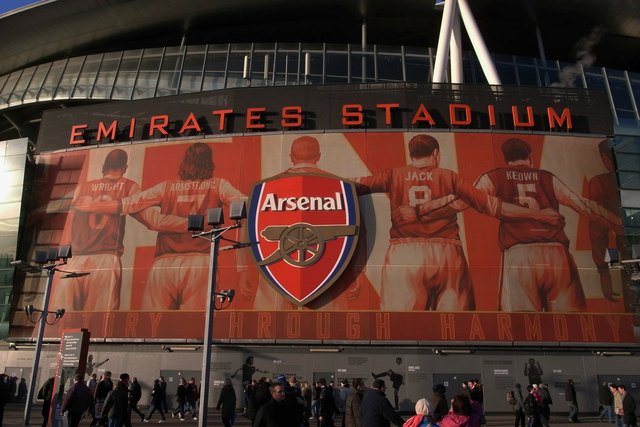
Three of us have just been to Emirates Stadium to see the Arsenal football club’s last friendly match before the new season starts. Some of us had been to the Arsenal Shop at the Stadium, and some of us had a stadium tour before, but none of us had yet seen a game. Our plan was to take the tube, the Piccadilly line, to Holloway Road, as we had done in the past on our previous visits to the area. We had plenty of time. We aimed to be there about an hour before kickoff. We were not alone on the tube, there were plenty of people in Arsenal shirts. When we got closer to the stadium, the train driver announced that the Holloway Rd tube stop was closed and that the train would not be stopping there. I believe this was due to it being a pretty small tube station with fairly narrow exits and some lifts not working. It may be that they close Holloway Rd tube station whenever there is a game on. Nobody on the train panicked and we simply readjusted our plan to get off the train at the next stop instead, at a stop aptly named Arsenal. I believe that even the train driver was a bit surprised, although not unduly, when he announced that the Arsenal tube station was also closed, and we would all have to wait to get off at the tube station after that: Finsbury Park. Again, nobody panicked, but there were some more animated conversations on the train now. By the way, this is not a blog post about panic, nobody panics at any point during this story. But something interesting did happen. And I am getting to it.
We arrived at Finsbury Park tube station, the doors opened, and we made our way to the exit. For a while, there was only one useful direction we were told to take by the “Way Out” signs. We, and everybody else, followed these signs. We were a bit slow for some reason and were perhaps some of the last people in the crowd to get out of the station. At one point the crowd, which was mostly just ahead of us, got to an intersection, with multiple possible paths leading out. The whole throng was heading in the same one of the three possible directions. I feel there were three possibilities, but maybe there were only two. In any case, the throng then slowed down a bit. It takes a bit of time for people to get through the tube barriers – to “tap out” with their Oyster cards (or credit or debit cards). So, we slowed to almost a standstill, which allowed us to consider our options. Should we follow the throng, or should we aim for one of the other exits, that nobody was using? We were weighing the pros and cons, given the limited information we had. Another exit would be quicker as there would be no congestion. But we were not sure where this other exit would take us. Some tube stations in London have exits that are quite far from each other with roads and buildings between them that would be hard or at least time-consuming to cross. It would also take us some time to get our (Austrian) phones (if we even had any reception) to help us with the directions at a tube station. We felt that all these other people, almost all of them going to the game, with all their clearly visible Arsenal paraphernalia, probably knew what they were doing. At least some of them should probably know the quickest way from the inside of the tube station to the stadium. None of the others seemed much torn over the decision as to which of the two or three exits to take. So, in a matter of a few seconds, we decided to follow the throng through the somewhat congested exit it was taking.
We slowly followed the throng out of the station and then also along the roads. After a few turns and a few minutes of walking, I noticed that we passed another tube station entrance/exit. So did we all take the wrong exit after all? I am not 100% sure, and some people may have taken the exit that we have all taken because they really wanted to. After all, we were quite early and some of the Arsenal supporters may have wanted to go to a favorite pub somewhere in the vicinity before going to the stadium. But I do believe that many of us took what in hindsight we would consider the wrong route out of the station. Once I was back home I studied the Finsbury Park tube station map carefully. This is the nicest map I found, even if it is from 2016. There are three exits. The throng with us in tow left the station through the Wells Terrace exit (the one marked closed on this map, but it has reopened since 2016). The exit we passed later, actually we were going round clockwise, was the Seven Sisters exit in the south of the station, and south is where the Emirates Stadium lies. I also studied Google Maps for some time, and I am pretty convinced that it would have saved us some 5 minutes or so if we had taken the Seven Sisters exit instead of following the throng.
So, did we make a mistake? In hindsight, I guess, yes, but given what we believed at the time, we made the best decision. We believed that others knew better which the best exit to get to the Emirates Stadium would be, so we rationally followed the herd. Was our belief silly? No, I don’t think so. After all, we had almost no information to begin with as to which exit would be best. And it seems reasonable that we should at least attach a higher probability of the throng going through the right exit than the wrong exit. Should we now be shocked that the exit we all took was wrong after all (for most of us anyway)? No, we probably should have realized that there is no 100% guarantee that the throng did go through the right exit. After all, many of the eventual spectators of the game were not the usual Arsenal supporters – we, for instance, not being registered members of Arsenal would not normally be able to get tickets to a league game. Moreover, I believe that people usually get off at Arsenal tube station and not at Finsbury Park. Many people in the throng were, therefore, probably in a similar situation to us, they did not know which the best exit was and were also hoping that the people in front of them knew more than they did. What about the first few people out of the tube station? Well, maybe they also did not know perfectly and made an educated guess, which turned out to be wrong. Maybe, they had a different goal. Maybe they were the first out because they wanted to get their beer in their favorite local pub as quickly as possible and their favorite pub wasn’t quite on the fastest way to the stadium, but others behind them did not know that.
All in all, I believe that we found ourselves in a situation that is well described by the rational herding models that started with the 1992 paper “A Theory of Fads, Fashion, Custom, and Cultural Change as Informational Cascades” by Bikhchandani, Hirshleifer, and Welch, see also my previous post on rational herding on the Autobahn. One of the main points of these models is that, even though everyone in the model is rational, sometimes, ultimately, everyone makes the wrong decision, as it seems we have done in this case.
 The Game Theory of Everyday Life
[…] game. We witnessed and participated in some interesting rational herding walking to the stadium, as I described in my previous post. But once inside, we had another game-theoretic problem. The problem was caused by the fact that we […]
LikeLike