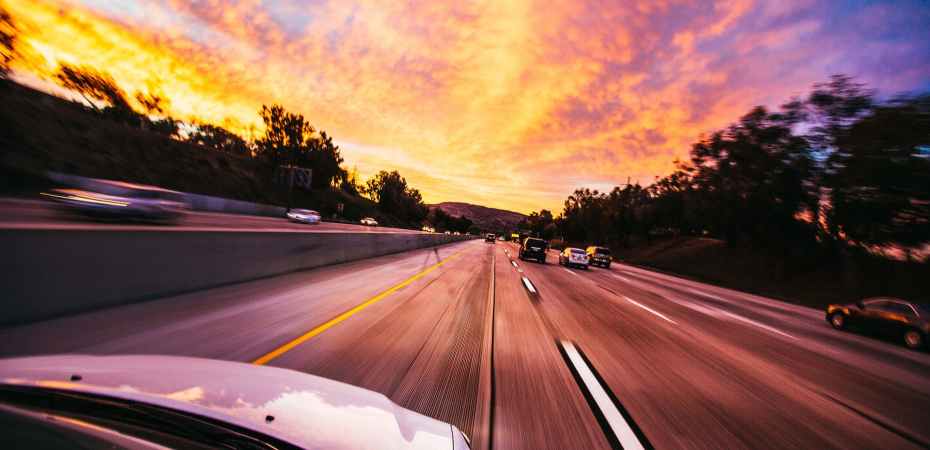
The speed limit on the Autobahn south of Graz to the Austrian/Slovenian border varies. Sometimes the speed limit is 130 km/h and sometimes it is 100 km/h. The speed limit is also not constant for the whole stretch of Autobahn and, after some distance from Graz, it definitely becomes 130 km/h. I don’t fully understand how these speed limit decisions are made and I also don’t quite know at which point the speed limit is definitely 130 km/h. I believe it has something to do with local pollution, so it may depend on weather or traffic conditions, but I don’t quite know. So, at least for me, the speed limit is a random variable and this is probably also true for most people. Now, what should I do when I am somewhere on this Autobahn at a point, where I am not sure what the speed limit is? I rationally “herd”.
Let me explain. To inform people about the speed limit, there are some, not many, electronic signs that can be programmed from some central place. The other day, when I drove south from Graz, I was initially in no doubt about the speed limit. One of these electronic signs just outside Graz was clearly showing 100 km/h. So, I attached a probability pretty close to 1 to the event (as probability theorists like to call it) that the speed limit is 100 km/h and I drove accordingly. A little bit later there was another one of these signs and that sign, if anything, just made my subjective probability assessment of the event that the speed limit is 100 km/h even closer to 1, and I still drove accordingly. I then drove on for quite some time, perhaps 10 or 20 kilometers, a little bit lost in thought, when I realized that I hadn’t seen a speed limit sign recently. Did I miss them? There should have been one, I thought, and I probably didn’t notice it. So, what was the speed limit now?
I also noticed, and that possibly prompted my reevaluation of my speed limit beliefs, that I was being overtaken by some cars that were going pretty fast. You need to know that drivers on the Austrian Autobahn, by and large, obey the speed limits. Of course, this is not 100% true, and one has to take this into consideration. But with any car that I estimated to be going about 130km/h when they overtook me, my subjective probability assessment that the speed limit is 100km/h went down and down and down. After about 4 or 5 cars went past me at about 130 km/h, I was at the point where I attached a sufficiently high probability to the event that the speed limit is 130km/h that I also went 130 km/h. I didn’t need this probability to be 1, as the chances of being caught speeding and being fined for it are not that high, and I, of course, preferred to get to wherever I wanted to get to earlier rather than later.
After a few minutes of driving speedily along, I encountered the next speed sign and it showed 100 km/h. There is a small probability that the speed limit had been temporarily (I mean on that stretch of Autobahn that I just had been on) 130 km/h, but it is a small one. So, I and the other drivers were wrong. Or were we? I would like to say that I was not wrong because I did not attach a probability of 1 to the event that the speed limit was 130 km/h. And possibly the other drivers also did not. The question is this: did or did we not also take into account that some of the other drivers that were going 130 km/h were going 130 km/h because they had seen others go 130 km/h and had formed their belief on a similar basis as I did. It is quite possible (and perhaps we did take this into account) that the first driver that we all saw going 130 km/h did this by mistake or just because they didn’t care. Perhaps this one driver was already enough, however, for a second driver to change their beliefs sufficiently for them to increase their speed and that, in turn, prompted a third and that a fourth and that me to start to go faster.
All of these decisions could be declared as being rational decisions as long as none of us were fooled into believing with certainty that the speed limit was now 130 km/h. We imitated the behavior of others before us, rationally thinking that their behavior provided evidence that the speed limit was 130 km/h. Often this assessment would have been correct. In the present case, it was not. This is, unfortunately, something that can happen when people rationally “herd on” others’ behavior. You may want to think about this when, for instance, you see an advert stating that one million people have bought whatever-it-is they are advertising and, therefore, the advert claims, so should you. But why have those others bought whatever-it-is? Maybe for the same reasons as you are just about to buy it? Because others have bought it? There is possibly less information in this statement than you think. For those who are interested: The literature on rational herding goes back to at least the 1992 paper “A Theory of Fads, Fashion, Custom, and Cultural Change as Informational Cascades” by Bikhchandani, Hirshleifer, and Welch and is still going strong, see the 2021 NBER working paper “Information Cascades and Social Learning” by the same authors plus Omer Tamuz.
 The Game Theory of Everyday Life
[…] of the people in the story of the emperor’s new clothes as one of rational herding (as in a previous post and see literature) with, possibly but not necessarily, psychological […]
LikeLike
[…] as Informational Cascades” by Bikhchandani, Hirshleifer, and Welch, see also my previous post on rational herding on the Autobahn. One of the main points of these models is that, even though everyone in the model is rational, […]
LikeLike