
You find economic forces at work in the unlikeliest of places. One of my kids got me into playing Fifa 23, a fairly popular football (or soccer if you prefer) video game. One possibility in this video game is to play Ultimate Team, in which you build your own team that you gradually improve and with which you can play against the computer or random people somewhere in the world. The way to improve your team is by getting new and better players (player cards really) and there are essentially two ways to get those: through earning or buying packs of typically random player cards or through buying specific player cards directly. Fifa Ultimate Team has a currency, Fifa coins (in fact they have two currencies – but this is not important for our purposes here), and it has a market, in which you can buy and sell player cards from and to the other game participants. This market is as much subject to the logic of supply and demand as any market in the “real” world. It is perhaps even more fun and more insightful to study because it has much more pronounced and more severe demand and supply changes (or even shocks as some would call it) that can sometimes cause much more drastic price changes. In this post, I want to study some of those.
As a first approximation, the monetary value (or trading price) of player cards depends mostly on two factors, the overall ability score of a player (the lowest I have seen is somewhere in the 40s, and the highest I believe is 99) and, already to a much lesser extent, the player’s position (I believe that goalkeepers tend to be valued somewhat less than strikers, for instance). On the whole, bronze player cards that have an ability score of 64 or less, tend to be cheaper than silver cards (ability score between 65 and 74) and those, in turn, tend to be cheaper than gold cards (ability score of 75 or more). But this is not consistently so and certainly not always so. I didn’t do a full empirical investigation, but I believe that, for instance, silver player cards with a score of 74 tend to be higher priced than gold player cards with a score between 75 and 80. The reason for this, I believe, is not so much that they are rarer (that would be a supply-side argument) but that the demand for 74 silver players is higher than those of gold players in the high 70s. And the reason for the higher demand for 74 silver players, in turn, is that there are certain objectives that people playing the game can fulfill only with silver players, sometimes only with 74 silver players, that allow these people to earn interesting (potentially valuable) player packs.
Some objectives are always there, but some are only temporary and not completely foreseeable. This can give rise to severe demand shocks with drastic price changes. A nice example of such a shock, that my son and I have experienced, was an objective in mid-May 2023, that required, among other things, that you score goals with players from Hertha Berlin. Futbin.com keeps track of the historical prices of player cards. Let me look at two players from Hertha Berlin, Jovetić and Lukébakio, one a striker (ST) and the other a right midfield player (RM). As you can see in the figures below, the prices for both cards were fairly stable between 200 and 500 Fifa coins for a long time. Then the new objective appeared, creating a sudden demand for both players, and their price shot up to initially about 8000 Fifa coins. That price hike only lasted a short time (perhaps one day if even that long) and the price quickly came down to between 2000 and 4000 Fifa coins. This lasted some time (a bit more than a week) before the prices came back down to their original level. This was when the objective, and the resulting demand shock, was over. For comparison, see below also the price evolution for the similar player cards of Wind (ST) and Thielmann (RM), both with similar scores than the two Hertha Berlin players (respectively) and both also playing in the German Bundesliga, but not for Hertha Berlin. For those two, you see no discernable price increase around the time of the objective around mid-May.
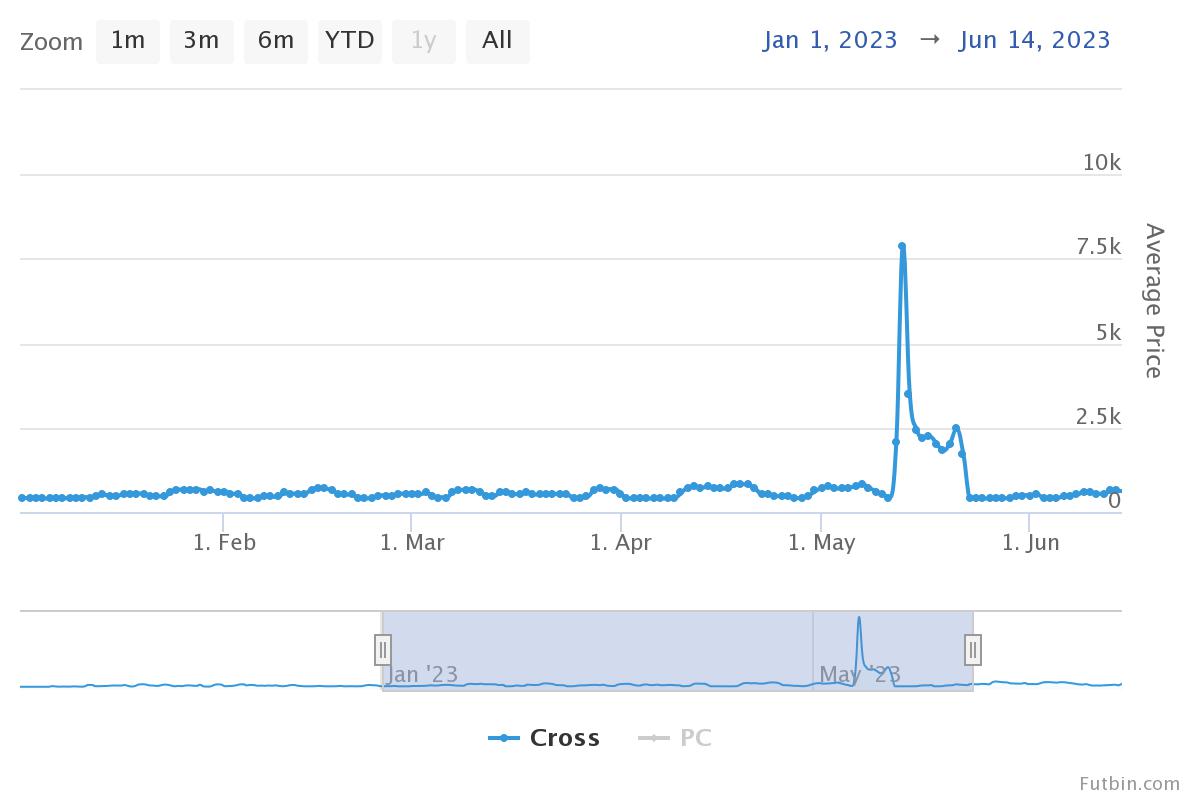
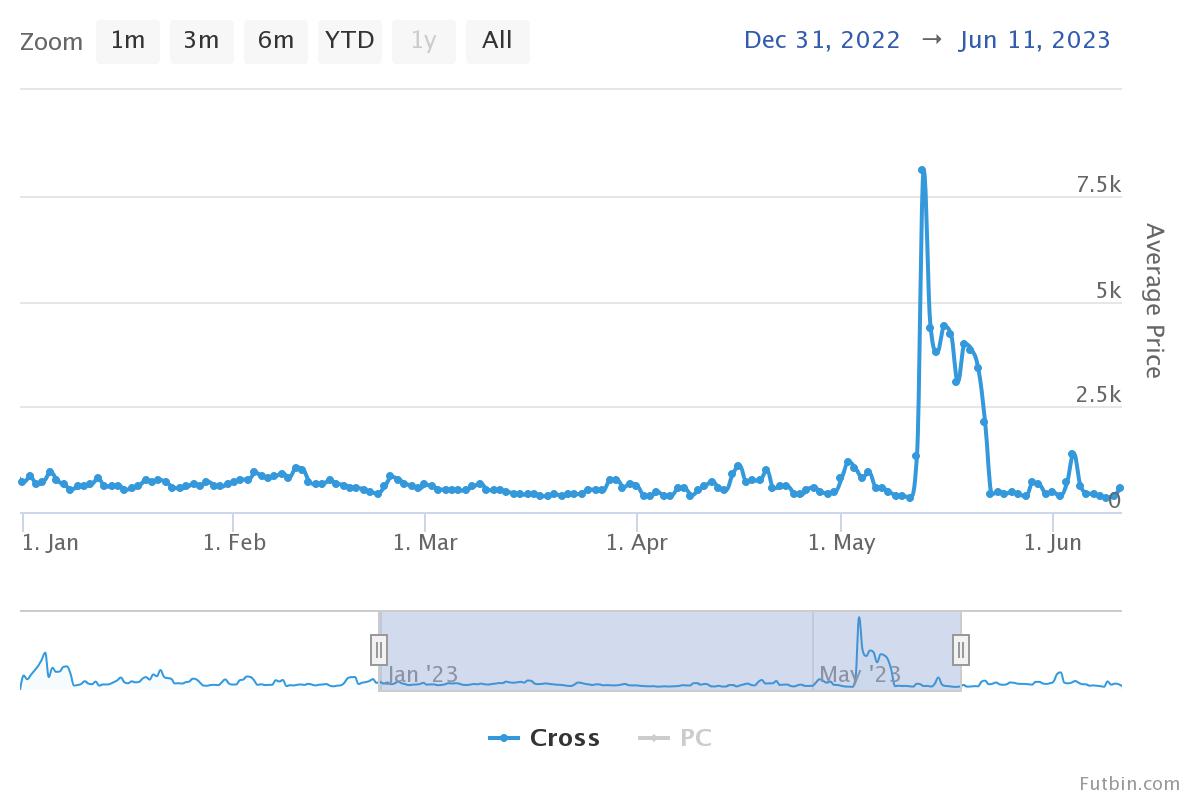

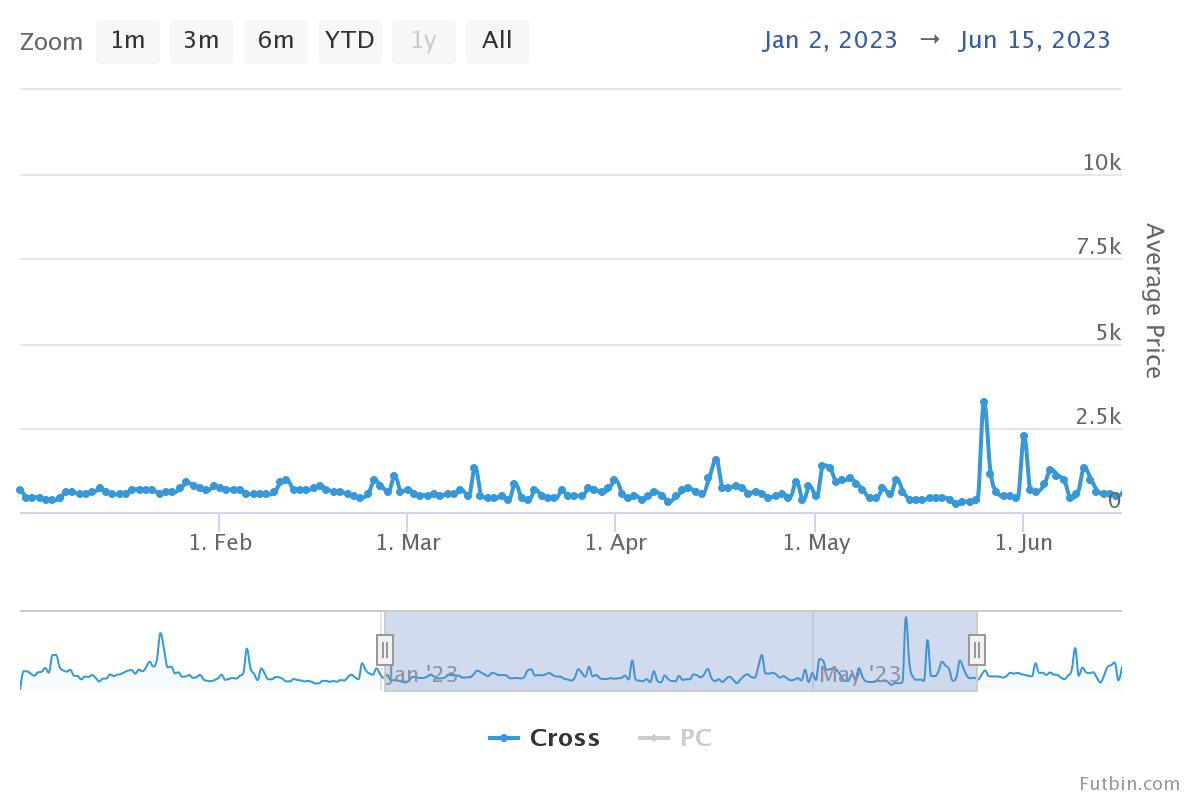
These figures were generated on July 26, 2023, on Futbin.com. The top row are prices for player cards Jovetić (left) and Lukébakio (right), the bottom row are prices for player cards Wind (left) and Thielmann (right).
I am not completely sure what exactly explains the initial price hike for the Hertha Berlin players beyond the eventual temporarily stable prices during which the objective was open. But I believe the price hike is a bit of an initial overreaction to the demand shock with a later quick convergence to the new equilibrium prices. I believe that this is caused by a quick increase in demand with a slower increase in the supply of these cards. I believe that it took the people who owned one of these cards a bit of time to realize that these cards just became more valuable and that it would now make sense to put these cards on the market to sell.
In any case, the Fifa 23 Ultimate Team market for player cards offers many fascinating episodes of quickly changing demand and supply and resulting price adjustments. If nobody has done so yet, perhaps someone should rigorously study this market and the economic forces at work behind it.
 The Game Theory of Everyday Life
[…] buy and sell online player cards through their online marketplace (with the Fifa 23 currency). See my previous post about the basic economics of supply and demand forces at work in this market. In this post, I want […]
LikeLike
[…] Continue reading. […]
LikeLike