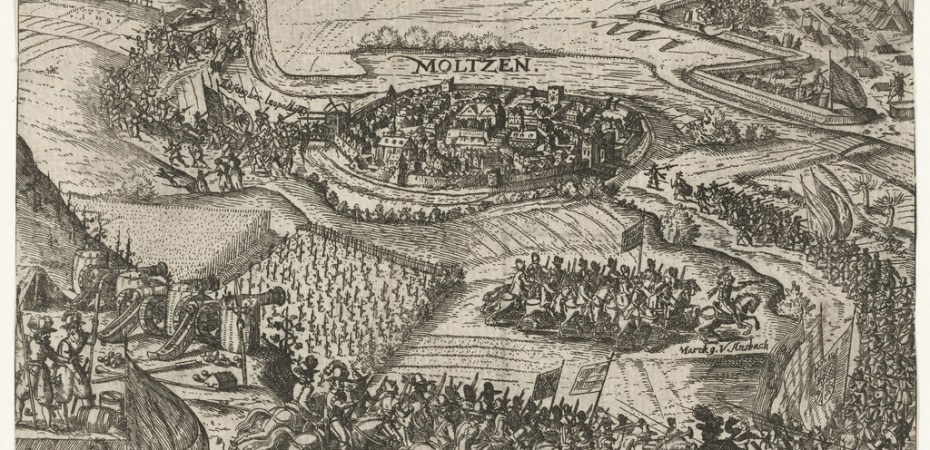
In C. S. Forester’s The Commodore, the main character Horatio Hornblower is in charge of a small squadron of ships of the (British) Royal Navy in the Baltic Sea. We are in the year 1812 and in the middle of the Napoleonic Wars. I am here interested in an episode in the book, in which Hornblower is assisting the Russians (who have just entered the war against Napoleon’s France) in their defense against the siege of Riga (which really happened).
One of the people in charge of the Russian defense in Riga (in the book, not in reality) is the Prussian officer Carl von Clausewitz. While he was probably not involved in the siege of Riga in real life, Clausewitz did leave the Prussian army (when it was part of the Napoleonic armies) in 1812 to support Russia against France. Clausewitz wrote a very influential treatise on warfare, mostly after the Napoleonic Wars, that emphasized strategic thinking. I find it quite interesting that Forester used Clausewitz as one of the main characters in the siege and through him we learn a lot about sieges.
A siege in the 18th and early 19th century seems to have been developed to the point where every part of it is predictable. Over the years, soldiers have learned (and been trained) how to behave in a siege so much so that, game theoretically speaking, equilibrium play has been reached. Even if both sides know exactly what the other side is (and will be) doing, they can only do what the other side expects them to do in return. There is no better strategy out there for either side. This is nicely described in the book. When Clausewitz and Hornblower overlook the siege from the gallery of a church, we are informed of (what are probably) Hornblower’s thoughts: “To a doctrinaire soldier a siege was an intellectual exercise. It was mathematically possible to calculate the rate of progress of the approaches and the destructible effect of the batteries, to predict every move and countermove in advance, and to foretell within an hour the moment of the final assault.”
So, what is the apparent equilibrium in a siege, then? Well, we should probably take a step back and briefly sketch the game we are talking about. First, the players. We are dealing with a war between two sides. Each side is, in reality, composed of a large group of individuals, but each group acts in a very coordinated manner as they all share the same goal (or are at least made to share the same goal). So, I feel it is safe to assume that there are simply two players: the besiegers and the besieged. It is also pretty clear what each side wants: the besiegers want to conquer Riga, the besieged want to avoid this from happening.
Ideally, from the besiegers’ point of view, they would just run up to Riga and claim it as theirs. But that is not a good strategy, as the besieged are protected by walls and guns and would just shoot the besiegers. So, instead, the besiegers start digging trenches and putting up “gabions”, something that “looked like a wall”, along these trenches. Such a protected trench is called a “sap”. The starting point of the sap is at a reasonably safe distance from the town’s guns. Then slowly the besiegers extend the sap forward along “parallels,” I guess, this means in a zigzag manner. While the besiegers slowly but persistently do this, the besieged shoot at them with their big guns. This shooting is rather ineffective, and they can apparently only damage the newest bit of the wall while it is erected. Hornblower at one point asks Clausewitz: “Why do your guns not stop the work on the sap?” to which Clausewitz replies: “They are trying, as you see. But a single gabion is not an easy target to hit at this range, and it is only the end which is vulnerable.” This sapping allows the besiegers to not only slowly come closer to the town walls, but to also bring up some of their big guns. As Clausewitz explains further: “And by the time the sap approaches within easy range their battery-fire will be silencing our guns.”
I expect that much of warfare has these very predictable aspects, especially if a war goes on for some time. And these predictable aspects can probably be well described by an equilibrium of an appropriate game between the two sides. Harder to understand using game theory (or anything else, really) are cases of innovative warfare. This is what Hornblower in all the books excels at, but you feel that these cases are rarer in real life. I once read that Hornblower is probably not modeled on any single real person in the British Royal Navy, but on many of them. One person can probably not come up with as many innovative strategies as Hornblower has throughout all the books. To be fair, most people probably didn’t even have the opportunity to do so.
In The Commodore, Hornblower, watching the siege operations alongside Clausewitz, is struggling to think how he could help with Riga’s defense. Clausewitz asks him at one point: “Can you not bring your ships up, sir? See how the water comes close to the works there. You could shoot them to pieces with your big guns.” But the problem was that the water there was way too shallow for Hornblower’s ships. Hornblower explains this to “an unsympathetic ear” and is frustrated by his inability to help. He walks around his cabin and is further frustrated by the restricted space, when suddenly, while just climbing over a rail, with “one leg in mid-air”, an “idea came to him”. [I quite like how Hornblower’s ideas come to him – it is very much like I (and many theorists, I believe) do research.] Hornblower realizes that there could be a way to lift his ships almost out of the water by attaching little loaded boats or barrels full of sand (or something like that) to the ship and then unloading them. He then has the two “bomb-ketches” in his squadron lifted in this way and brings them into action for a few hours to devastating effect on the sapping operation.
Hornblower’s novel strategy was something that the besiegers were clearly not even aware of as being possible. For the besiegers, this was, in Donald Rumsfeld’s terminology, an “unknown unknown”. Similar surprising moves have been made recently by the Ukraine bombing Russian bomber planes using a complex operation deep in Russia, and by Israel with the exploding pagers. In those two cases, the other side was most likely also not even aware of these possibilities. Having done this once, however, one would assume that this cannot easily be done again, as the other side, now being aware of such possibilities, can probably put preventative measures in place. In Hornblower’s case, the French react by bringing up a battery of guns towards the lifted ships within a few hours and keep them there for the remainder of the siege.
Interestingly, and that again, because of the highly predictable siege equilibrium, Clausewitz can precisely quantify that Hornblower’s innovative strategy has delayed the besiegers by no more than four days.
 The Game Theory of Everyday Life